Uses Grid graphics to draw a flower glyph
(Van Onzenoodt et al. 2023)
. Each variable in z
is depicted as a "petal" radiating from a central point, with the petal
length scaled according to the corresponding value in z. The
silhouette of each petal is generated from a continuous parametric taper
profile whose widening from the base and tapering towards the tip are
controlled independently by petal.base.shape and
petal.tip.shape. An optional notch at the tip, controlled by
petal.tip.notch, can be used to produce cleft (bifid) or heart-shaped
petals.
Usage
flowerglyphGrob(
  x = 0.5,
  y = 0.5,
  z,
  size = 1,
  petal.width = 0.6,
  petal.base.shape = 1,
  petal.tip.shape = 1,
  petal.tip.notch = 0,
  petal.tip.notch.width = 0.15,
  petal.base.notch = 0,
  petal.base.notch.width = 0.15,
  petal.waist = 0,
  petal.waist.position = 0.5,
  petal.waist.width = 0.15,
  petal.curvature = 0,
  petal.curvature.position = 0.7,
  petal.curvature.width = 0.2,
  edges = 30,
  col = "black",
  fill = NA,
  lwd = 1,
  alpha = 1,
  angle.start = 0,
  angle.stop = 2 * base::pi,
  linejoin = c("mitre", "round", "bevel"),
  scale.length = TRUE,
  scale.area = FALSE,
  centre = TRUE,
  centre.size = 1,
  col.centre = "black",
  fill.centre = "black",
  draw.grid = FALSE,
  grid.levels = NULL,
  col.grid = "grey",
  lwd.grid = lwd
)
Arguments
- x
A numeric vector or unit object specifying x-locations.
- y
A numeric vector or unit object specifying y-locations.
- z
A numeric vector specifying the values to be plotted as the length of the flower glyph petals.
- size
The size of the glyph (scales both petal length and width).
- petal.width
The width of a petal (as a proportion of
size|) at its widest point.- petal.base.shape
A positive numeric value controlling how rapidly the petal widens from its base. Smaller values produce a broader attachment to the centre of the glyph, whereas larger values delay the expansion of the petal, producing a narrower, more clawed base.
- petal.tip.shape
A positive numeric value controlling how rapidly the petal tapers towards its tip. Smaller values produce broader, more rounded tips, whereas larger values concentrate the petal width closer to its middle, producing progressively narrower, more pointed or lanceolate tips.
- petal.tip.notch
A numeric value controlling deformation of the petal tip. A value of
0produces a smooth, unmodified tip. Positive values (typically \(> 0\)) create an increasingly deep inward cleft with smooth shoulders, producing retuse, emarginate, obcordate, or bifid petal tips. Negative values extend the tip beyond its nominal length, producing progressively more acuminate, cuspidate, or aristate tips.- petal.tip.notch.width
A positive numeric value controlling the breadth of the tip notch. Smaller values produce a narrow, sharply incised cleft, or point, whereas larger values produce a broader, more rounded indentation or extension.
- petal.base.notch
A numeric value controlling deformation of the petal base. A value of
0produces a smooth, unmodified base. Positive values shift the basal shoulders backward relative to the central notch vertex (which remains anchored at the origin), producing cordate, sagittate, reniform, hastate, or auriculate petal shapes. Negative values extend the base into a basal protrusion or claw.- petal.base.notch.width
A positive numeric value controlling the breadth of the basal notch or protrusion. Smaller values produce a narrow, sharply defined sinus or point, whereas larger values produce a broader, more rounded basal indentation or extension.
- petal.waist
A numeric value controlling the depth of a constriction along the petal. A value of
0produces a uniformly tapered petal, whereas larger values produce an increasingly pronounced narrowing, resulting in pandurate, fiddle-shaped, or otherwise constricted petals.- petal.waist.position
A numeric value between
0and1controlling the position of the waist along the petal axis, where0corresponds to the base and1to the tip.- petal.waist.width
A positive numeric value controlling the breadth of the waist. Smaller values produce a sharp, localized constriction, whereas larger values produce a broader, more gradual narrowing.
- petal.curvature
A numeric value or vector controlling the curvature of the petal centreline. A value of
0produces a straight petal, whereas single positive or negative values produce simple arcuate or falcate (C-shaped) curvature in opposite directions. Passing a vector specifies multiple curvature bends along the petal axis; for example, a vector of length 2 with opposing signs (e.g.,c(3.0, -3.0)) produces a sigmoid (S-shaped) petal.- petal.curvature.position
A numeric value or vector between
0and1controlling the position of maximum curvature along the petal axis, where0corresponds to the base and1to the tip. Whenpetal.curvatureis a vector specifying multiple bends (e.g., for sigmoid shapes), this parameter specifies the location along the axis for each corresponding bend.- petal.curvature.width
A positive numeric value controlling the breadth of the region over which the petal bends. Smaller values concentrate the curvature into a localized bend, whereas larger values distribute the curvature more evenly along the petal, producing a broader, more gradual arc.
- edges
The number of points used to approximate the taper profile of one side of a petal. Higher values give smoother petal outlines.
- col
The petal outline colour.
- fill
The petal fill colour.
- lwd
The petal outline line width.
- alpha
The alpha transparency value.
- angle.start
The start angle for the petals in radians. Default is zero.
- angle.stop
The stop angle for the petals in radians. Default is \(2\pi\).
- linejoin
The line join style for the petal outlines. Either
"mitre","round"or"bevel".- scale.length
logical. If
TRUE, the petal lengths are scaled according to value ofz.- scale.area
logical. If
TRUE, the area of the petals are scaled according to value ofz.- centre
logical. If
TRUE, a central point is drawn at the glyph origin. Default isTRUE.- centre.size
The size (radius, in mm) of the central point.
- col.centre
The line colour of the central point.
- fill.centre
The fill colour of the central point.
- draw.grid
logical. If
TRUE, grid levels are plotted as nested petals. Default isFALSE.- grid.levels
A list of grid levels (as vectors) corresponding to the values in
zat which points are to be plotted. The values inzshould be present in the list specified.- col.grid
The colour of the nested grid petal lines.
- lwd.grid
The line width of the nested grid petal lines.
Value
A gTree object.
References
Van Onzenoodt C, Vazquez P, Ropinski T (2023). “Out of the plane: Flower versus star glyphs to support high-dimensional exploration in two-dimensional embeddings.” IEEE Transactions on Visualization and Computer Graphics, 29(12), 5468–5482.
Examples
library(ggmultiglyph)
library(grid)
library(gridExtra)
z <- c(0.5, 0.8, 1.2, 0.6, 1, 0.7)
#~~~~~~~~~~~~~~~~~~~~~~~~~~~~~~~~~~~~~~~~~~~~~~~~~~~~~~~~~~~~~~~~~~~~~~~~~~~~
# Adjust length and area scaling
#~~~~~~~~~~~~~~~~~~~~~~~~~~~~~~~~~~~~~~~~~~~~~~~~~~~~~~~~~~~~~~~~~~~~~~~~~~~~
fg1 <- flowerglyphGrob(x = unit(0.5, "npc"), y = unit(0.5, "npc"),
z = z,
size = 20,
petal.base.shape = 1.25, petal.tip.shape = 1,
petal.width = 0.25,
scale.area = TRUE, scale.length = FALSE)
fg2 <- flowerglyphGrob(x = unit(0.5, "npc"), y = unit(0.5, "npc"),
z = z,
size = 20,
petal.base.shape = 1.25, petal.tip.shape = 1,
petal.width = 0.25,
scale.area = FALSE, scale.length = TRUE)
fg3 <- flowerglyphGrob(x = unit(0.5, "npc"), y = unit(0.5, "npc"),
z = z,
size = 20,
petal.base.shape = 1.25, petal.tip.shape = 1,
petal.width = 0.25,
scale.area = FALSE, scale.length = FALSE)
grid.arrange(fg1, fg2, fg3, nrow = 1)
 #~~~~~~~~~~~~~~~~~~~~~~~~~~~~~~~~~~~~~~~~~~~~~~~~~~~~~~~~~~~~~~~~~~~~~~~~~~~~
# Adjust flower size
#~~~~~~~~~~~~~~~~~~~~~~~~~~~~~~~~~~~~~~~~~~~~~~~~~~~~~~~~~~~~~~~~~~~~~~~~~~~~
fg1 <- flowerglyphGrob(x = unit(0.5, "npc"), y = unit(0.5, "npc"),
z = z,
size = 10,
petal.base.shape = 1.25, petal.tip.shape = 1,
petal.width = 0.25,
scale.area = TRUE, scale.length = FALSE)
fg2 <- flowerglyphGrob(x = unit(0.5, "npc"), y = unit(0.5, "npc"),
z = z,
size = 15,
petal.base.shape = 1.25, petal.tip.shape = 1,
petal.width = 0.25,
scale.area = TRUE, scale.length = FALSE)
fg3 <- flowerglyphGrob(x = unit(0.5, "npc"), y = unit(0.5, "npc"),
z = z,
size = 20,
petal.base.shape = 1.25, petal.tip.shape = 1,
petal.width = 0.25,
scale.area = TRUE, scale.length = FALSE)
grid.arrange(fg1, fg2, fg3, nrow = 1)
#~~~~~~~~~~~~~~~~~~~~~~~~~~~~~~~~~~~~~~~~~~~~~~~~~~~~~~~~~~~~~~~~~~~~~~~~~~~~
# Adjust flower size
#~~~~~~~~~~~~~~~~~~~~~~~~~~~~~~~~~~~~~~~~~~~~~~~~~~~~~~~~~~~~~~~~~~~~~~~~~~~~
fg1 <- flowerglyphGrob(x = unit(0.5, "npc"), y = unit(0.5, "npc"),
z = z,
size = 10,
petal.base.shape = 1.25, petal.tip.shape = 1,
petal.width = 0.25,
scale.area = TRUE, scale.length = FALSE)
fg2 <- flowerglyphGrob(x = unit(0.5, "npc"), y = unit(0.5, "npc"),
z = z,
size = 15,
petal.base.shape = 1.25, petal.tip.shape = 1,
petal.width = 0.25,
scale.area = TRUE, scale.length = FALSE)
fg3 <- flowerglyphGrob(x = unit(0.5, "npc"), y = unit(0.5, "npc"),
z = z,
size = 20,
petal.base.shape = 1.25, petal.tip.shape = 1,
petal.width = 0.25,
scale.area = TRUE, scale.length = FALSE)
grid.arrange(fg1, fg2, fg3, nrow = 1)
 fg1 <- flowerglyphGrob(x = unit(0.5, "npc"), y = unit(0.5, "npc"),
z = z,
size = 10,
petal.base.shape = 1.25, petal.tip.shape = 1,
petal.width = 0.25,
scale.area = FALSE, scale.length = TRUE)
fg2 <- flowerglyphGrob(x = unit(0.5, "npc"), y = unit(0.5, "npc"),
z = z,
size = 15,
petal.base.shape = 1.25, petal.tip.shape = 1,
petal.width = 0.25,
scale.area = FALSE, scale.length = TRUE)
fg3 <- flowerglyphGrob(x = unit(0.5, "npc"), y = unit(0.5, "npc"),
z = z,
size = 20,
petal.base.shape = 1.25, petal.tip.shape = 1,
petal.width = 0.25,
scale.area = FALSE, scale.length = TRUE)
grid.arrange(fg1, fg2, fg3, nrow = 1)
fg1 <- flowerglyphGrob(x = unit(0.5, "npc"), y = unit(0.5, "npc"),
z = z,
size = 10,
petal.base.shape = 1.25, petal.tip.shape = 1,
petal.width = 0.25,
scale.area = FALSE, scale.length = TRUE)
fg2 <- flowerglyphGrob(x = unit(0.5, "npc"), y = unit(0.5, "npc"),
z = z,
size = 15,
petal.base.shape = 1.25, petal.tip.shape = 1,
petal.width = 0.25,
scale.area = FALSE, scale.length = TRUE)
fg3 <- flowerglyphGrob(x = unit(0.5, "npc"), y = unit(0.5, "npc"),
z = z,
size = 20,
petal.base.shape = 1.25, petal.tip.shape = 1,
petal.width = 0.25,
scale.area = FALSE, scale.length = TRUE)
grid.arrange(fg1, fg2, fg3, nrow = 1)
 fg1 <- flowerglyphGrob(x = unit(0.5, "npc"), y = unit(0.5, "npc"),
z = z,
size = 10,
petal.base.shape = 1.25, petal.tip.shape = 1,
petal.width = 0.25,
scale.area = FALSE, scale.length = FALSE)
fg2 <- flowerglyphGrob(x = unit(0.5, "npc"), y = unit(0.5, "npc"),
z = z,
size = 15,
petal.base.shape = 1.25, petal.tip.shape = 1,
petal.width = 0.25,
scale.area = FALSE, scale.length = FALSE)
fg3 <- flowerglyphGrob(x = unit(0.5, "npc"), y = unit(0.5, "npc"),
z = z,
size = 20,
petal.base.shape = 1.25, petal.tip.shape = 1,
petal.width = 0.25,
scale.area = FALSE, scale.length = FALSE)
grid.arrange(fg1, fg2, fg3, nrow = 1)
fg1 <- flowerglyphGrob(x = unit(0.5, "npc"), y = unit(0.5, "npc"),
z = z,
size = 10,
petal.base.shape = 1.25, petal.tip.shape = 1,
petal.width = 0.25,
scale.area = FALSE, scale.length = FALSE)
fg2 <- flowerglyphGrob(x = unit(0.5, "npc"), y = unit(0.5, "npc"),
z = z,
size = 15,
petal.base.shape = 1.25, petal.tip.shape = 1,
petal.width = 0.25,
scale.area = FALSE, scale.length = FALSE)
fg3 <- flowerglyphGrob(x = unit(0.5, "npc"), y = unit(0.5, "npc"),
z = z,
size = 20,
petal.base.shape = 1.25, petal.tip.shape = 1,
petal.width = 0.25,
scale.area = FALSE, scale.length = FALSE)
grid.arrange(fg1, fg2, fg3, nrow = 1)
 #~~~~~~~~~~~~~~~~~~~~~~~~~~~~~~~~~~~~~~~~~~~~~~~~~~~~~~~~~~~~~~~~~~~~~~~~~~~~
# Adjust circle size
#~~~~~~~~~~~~~~~~~~~~~~~~~~~~~~~~~~~~~~~~~~~~~~~~~~~~~~~~~~~~~~~~~~~~~~~~~~~~
fg1 <- flowerglyphGrob(x = unit(0.5, "npc"), y = unit(0.5, "npc"),
z = z,
size = 20, centre.size = 1,
petal.base.shape = 1.25, petal.tip.shape = 1,
petal.width = 0.25,
scale.area = TRUE, scale.length = FALSE)
fg2 <- flowerglyphGrob(x = unit(0.5, "npc"), y = unit(0.5, "npc"),
z = z,
size = 20, centre.size = 2.5,
petal.base.shape = 1.25, petal.tip.shape = 1,
petal.width = 0.25,
scale.area = TRUE, scale.length = FALSE)
fg3 <- flowerglyphGrob(x = unit(0.5, "npc"), y = unit(0.5, "npc"),
z = z,
size = 20, centre.size = 5,
petal.base.shape = 1.25, petal.tip.shape = 1,
petal.width = 0.25,
scale.area = TRUE, scale.length = FALSE)
grid.arrange(fg1, fg2, fg3, nrow = 1)
#~~~~~~~~~~~~~~~~~~~~~~~~~~~~~~~~~~~~~~~~~~~~~~~~~~~~~~~~~~~~~~~~~~~~~~~~~~~~
# Adjust circle size
#~~~~~~~~~~~~~~~~~~~~~~~~~~~~~~~~~~~~~~~~~~~~~~~~~~~~~~~~~~~~~~~~~~~~~~~~~~~~
fg1 <- flowerglyphGrob(x = unit(0.5, "npc"), y = unit(0.5, "npc"),
z = z,
size = 20, centre.size = 1,
petal.base.shape = 1.25, petal.tip.shape = 1,
petal.width = 0.25,
scale.area = TRUE, scale.length = FALSE)
fg2 <- flowerglyphGrob(x = unit(0.5, "npc"), y = unit(0.5, "npc"),
z = z,
size = 20, centre.size = 2.5,
petal.base.shape = 1.25, petal.tip.shape = 1,
petal.width = 0.25,
scale.area = TRUE, scale.length = FALSE)
fg3 <- flowerglyphGrob(x = unit(0.5, "npc"), y = unit(0.5, "npc"),
z = z,
size = 20, centre.size = 5,
petal.base.shape = 1.25, petal.tip.shape = 1,
petal.width = 0.25,
scale.area = TRUE, scale.length = FALSE)
grid.arrange(fg1, fg2, fg3, nrow = 1)
 fg1 <- flowerglyphGrob(x = unit(0.5, "npc"), y = unit(0.5, "npc"),
z = z,
size = 20, centre.size = 1,
petal.base.shape = 1.25, petal.tip.shape = 1,
petal.width = 0.25,
scale.area = FALSE, scale.length = TRUE)
fg2 <- flowerglyphGrob(x = unit(0.5, "npc"), y = unit(0.5, "npc"),
z = z,
size = 20, centre.size = 2.5,
petal.base.shape = 1.25, petal.tip.shape = 1,
petal.width = 0.25,
scale.area = FALSE, scale.length = TRUE)
fg3 <- flowerglyphGrob(x = unit(0.5, "npc"), y = unit(0.5, "npc"),
z = z,
size = 20, centre.size = 5,
petal.base.shape = 1.25, petal.tip.shape = 1,
petal.width = 0.25,
scale.area = FALSE, scale.length = TRUE)
grid.arrange(fg1, fg2, fg3, nrow = 1)
fg1 <- flowerglyphGrob(x = unit(0.5, "npc"), y = unit(0.5, "npc"),
z = z,
size = 20, centre.size = 1,
petal.base.shape = 1.25, petal.tip.shape = 1,
petal.width = 0.25,
scale.area = FALSE, scale.length = TRUE)
fg2 <- flowerglyphGrob(x = unit(0.5, "npc"), y = unit(0.5, "npc"),
z = z,
size = 20, centre.size = 2.5,
petal.base.shape = 1.25, petal.tip.shape = 1,
petal.width = 0.25,
scale.area = FALSE, scale.length = TRUE)
fg3 <- flowerglyphGrob(x = unit(0.5, "npc"), y = unit(0.5, "npc"),
z = z,
size = 20, centre.size = 5,
petal.base.shape = 1.25, petal.tip.shape = 1,
petal.width = 0.25,
scale.area = FALSE, scale.length = TRUE)
grid.arrange(fg1, fg2, fg3, nrow = 1)
 fg1 <- flowerglyphGrob(x = unit(0.5, "npc"), y = unit(0.5, "npc"),
z = z,
size = 20, centre.size = 1,
petal.base.shape = 1.25, petal.tip.shape = 1,
petal.width = 0.25,
scale.area = FALSE, scale.length = FALSE)
fg2 <- flowerglyphGrob(x = unit(0.5, "npc"), y = unit(0.5, "npc"),
z = z,
size = 20, centre.size = 2.5,
petal.base.shape = 1.25, petal.tip.shape = 1,
petal.width = 0.25,
scale.area = FALSE, scale.length = FALSE)
fg3 <- flowerglyphGrob(x = unit(0.5, "npc"), y = unit(0.5, "npc"),
z = z,
size = 20, centre.size = 5,
petal.base.shape = 1.25, petal.tip.shape = 1,
petal.width = 0.25,
scale.area = FALSE, scale.length = FALSE)
grid.arrange(fg1, fg2, fg3, nrow = 1)
fg1 <- flowerglyphGrob(x = unit(0.5, "npc"), y = unit(0.5, "npc"),
z = z,
size = 20, centre.size = 1,
petal.base.shape = 1.25, petal.tip.shape = 1,
petal.width = 0.25,
scale.area = FALSE, scale.length = FALSE)
fg2 <- flowerglyphGrob(x = unit(0.5, "npc"), y = unit(0.5, "npc"),
z = z,
size = 20, centre.size = 2.5,
petal.base.shape = 1.25, petal.tip.shape = 1,
petal.width = 0.25,
scale.area = FALSE, scale.length = FALSE)
fg3 <- flowerglyphGrob(x = unit(0.5, "npc"), y = unit(0.5, "npc"),
z = z,
size = 20, centre.size = 5,
petal.base.shape = 1.25, petal.tip.shape = 1,
petal.width = 0.25,
scale.area = FALSE, scale.length = FALSE)
grid.arrange(fg1, fg2, fg3, nrow = 1)
 #~~~~~~~~~~~~~~~~~~~~~~~~~~~~~~~~~~~~~~~~~~~~~~~~~~~~~~~~~~~~~~~~~~~~~~~~~~~~
# Adjust angle
#~~~~~~~~~~~~~~~~~~~~~~~~~~~~~~~~~~~~~~~~~~~~~~~~~~~~~~~~~~~~~~~~~~~~~~~~~~~~
fg1 <- flowerglyphGrob(x = unit(0.5, "npc"), y = unit(0.5, "npc"),
z = z,
size = 20,
petal.base.shape = 1.25, petal.tip.shape = 1,
petal.width = 0.25,
scale.area = TRUE, scale.length = FALSE)
fg2 <- flowerglyphGrob(x = unit(0.5, "npc"), y = unit(0.5, "npc"),
z = z,
size = 20,
petal.base.shape = 1.25, petal.tip.shape = 1,
petal.width = 0.25,
scale.area = TRUE, scale.length = FALSE,
angle.start = 0, angle.stop = base::pi)
fg3 <- flowerglyphGrob(x = unit(0.5, "npc"), y = unit(0.5, "npc"),
z = z,
size = 20,
petal.base.shape = 1.25, petal.tip.shape = 1,
petal.width = 0.25,
scale.area = TRUE, scale.length = FALSE,
angle.start = 90 * (base::pi/180),
angle.stop = 270 * (base::pi/180))
grid.arrange(fg1, fg2, fg3, nrow = 1)
#~~~~~~~~~~~~~~~~~~~~~~~~~~~~~~~~~~~~~~~~~~~~~~~~~~~~~~~~~~~~~~~~~~~~~~~~~~~~
# Adjust angle
#~~~~~~~~~~~~~~~~~~~~~~~~~~~~~~~~~~~~~~~~~~~~~~~~~~~~~~~~~~~~~~~~~~~~~~~~~~~~
fg1 <- flowerglyphGrob(x = unit(0.5, "npc"), y = unit(0.5, "npc"),
z = z,
size = 20,
petal.base.shape = 1.25, petal.tip.shape = 1,
petal.width = 0.25,
scale.area = TRUE, scale.length = FALSE)
fg2 <- flowerglyphGrob(x = unit(0.5, "npc"), y = unit(0.5, "npc"),
z = z,
size = 20,
petal.base.shape = 1.25, petal.tip.shape = 1,
petal.width = 0.25,
scale.area = TRUE, scale.length = FALSE,
angle.start = 0, angle.stop = base::pi)
fg3 <- flowerglyphGrob(x = unit(0.5, "npc"), y = unit(0.5, "npc"),
z = z,
size = 20,
petal.base.shape = 1.25, petal.tip.shape = 1,
petal.width = 0.25,
scale.area = TRUE, scale.length = FALSE,
angle.start = 90 * (base::pi/180),
angle.stop = 270 * (base::pi/180))
grid.arrange(fg1, fg2, fg3, nrow = 1)
 fg1 <- flowerglyphGrob(x = unit(0.5, "npc"), y = unit(0.5, "npc"),
z = z,
size = 20, centre.size = 1,
petal.base.shape = 1.25, petal.tip.shape = 1,
petal.width = 0.25,
scale.area = FALSE, scale.length = TRUE)
fg2 <- flowerglyphGrob(x = unit(0.5, "npc"), y = unit(0.5, "npc"),
z = z,
size = 20, centre.size = 1,
petal.base.shape = 1.25, petal.tip.shape = 1,
petal.width = 0.25,
scale.area = FALSE, scale.length = TRUE,
angle.start = 0, angle.stop = base::pi)
fg3 <- flowerglyphGrob(x = unit(0.5, "npc"), y = unit(0.5, "npc"),
z = z,
size = 20, centre.size = 1,
petal.base.shape = 1.25, petal.tip.shape = 1,
petal.width = 0.25,
scale.area = FALSE, scale.length = TRUE,
angle.start = 90 * (base::pi/180),
angle.stop = 270 * (base::pi/180))
grid.arrange(fg1, fg2, fg3, nrow = 1)
fg1 <- flowerglyphGrob(x = unit(0.5, "npc"), y = unit(0.5, "npc"),
z = z,
size = 20, centre.size = 1,
petal.base.shape = 1.25, petal.tip.shape = 1,
petal.width = 0.25,
scale.area = FALSE, scale.length = TRUE)
fg2 <- flowerglyphGrob(x = unit(0.5, "npc"), y = unit(0.5, "npc"),
z = z,
size = 20, centre.size = 1,
petal.base.shape = 1.25, petal.tip.shape = 1,
petal.width = 0.25,
scale.area = FALSE, scale.length = TRUE,
angle.start = 0, angle.stop = base::pi)
fg3 <- flowerglyphGrob(x = unit(0.5, "npc"), y = unit(0.5, "npc"),
z = z,
size = 20, centre.size = 1,
petal.base.shape = 1.25, petal.tip.shape = 1,
petal.width = 0.25,
scale.area = FALSE, scale.length = TRUE,
angle.start = 90 * (base::pi/180),
angle.stop = 270 * (base::pi/180))
grid.arrange(fg1, fg2, fg3, nrow = 1)
 fg1 <- flowerglyphGrob(x = unit(0.5, "npc"), y = unit(0.5, "npc"),
z = z,
size = 20,
petal.base.shape = 1.25, petal.tip.shape = 1,
petal.width = 0.25,
scale.area = FALSE, scale.length = FALSE)
fg2 <- flowerglyphGrob(x = unit(0.5, "npc"), y = unit(0.5, "npc"),
z = z,
size = 20,
petal.base.shape = 1.25, petal.tip.shape = 1,
petal.width = 0.25,
scale.area = FALSE, scale.length = FALSE,
angle.start = 0, angle.stop = base::pi)
fg3 <- flowerglyphGrob(x = unit(0.5, "npc"), y = unit(0.5, "npc"),
z = z,
size = 20,
petal.base.shape = 1.25, petal.tip.shape = 1,
petal.width = 0.25,
scale.area = FALSE, scale.length = FALSE,
angle.start = 90 * (base::pi/180),
angle.stop = 270 * (base::pi/180))
grid.arrange(fg1, fg2, fg3, nrow = 1)
fg1 <- flowerglyphGrob(x = unit(0.5, "npc"), y = unit(0.5, "npc"),
z = z,
size = 20,
petal.base.shape = 1.25, petal.tip.shape = 1,
petal.width = 0.25,
scale.area = FALSE, scale.length = FALSE)
fg2 <- flowerglyphGrob(x = unit(0.5, "npc"), y = unit(0.5, "npc"),
z = z,
size = 20,
petal.base.shape = 1.25, petal.tip.shape = 1,
petal.width = 0.25,
scale.area = FALSE, scale.length = FALSE,
angle.start = 0, angle.stop = base::pi)
fg3 <- flowerglyphGrob(x = unit(0.5, "npc"), y = unit(0.5, "npc"),
z = z,
size = 20,
petal.base.shape = 1.25, petal.tip.shape = 1,
petal.width = 0.25,
scale.area = FALSE, scale.length = FALSE,
angle.start = 90 * (base::pi/180),
angle.stop = 270 * (base::pi/180))
grid.arrange(fg1, fg2, fg3, nrow = 1)
 #~~~~~~~~~~~~~~~~~~~~~~~~~~~~~~~~~~~~~~~~~~~~~~~~~~~~~~~~~~~~~~~~~~~~~~~~~~~~
# Adjust line widths
#~~~~~~~~~~~~~~~~~~~~~~~~~~~~~~~~~~~~~~~~~~~~~~~~~~~~~~~~~~~~~~~~~~~~~~~~~~~~
fg1 <- flowerglyphGrob(x = unit(0.5, "npc"), y = unit(0.5, "npc"),
z = z,
size = 20,
petal.base.shape = 1.25, petal.tip.shape = 1,
petal.width = 0.25,
scale.area = TRUE, scale.length = FALSE)
fg2 <- flowerglyphGrob(x = unit(0.5, "npc"), y = unit(0.5, "npc"),
z = z,
size = 20,
petal.base.shape = 1.25, petal.tip.shape = 1,
petal.width = 0.25,
scale.area = TRUE, scale.length = FALSE,
lwd = 3)
fg3 <- flowerglyphGrob(x = unit(0.5, "npc"), y = unit(0.5, "npc"),
z = z,
size = 20,
petal.base.shape = 1.25, petal.tip.shape = 1,
petal.width = 0.25,
scale.area = TRUE, scale.length = FALSE,
lwd = 5)
grid.arrange(fg1, fg2, fg3, nrow = 1)
#~~~~~~~~~~~~~~~~~~~~~~~~~~~~~~~~~~~~~~~~~~~~~~~~~~~~~~~~~~~~~~~~~~~~~~~~~~~~
# Adjust line widths
#~~~~~~~~~~~~~~~~~~~~~~~~~~~~~~~~~~~~~~~~~~~~~~~~~~~~~~~~~~~~~~~~~~~~~~~~~~~~
fg1 <- flowerglyphGrob(x = unit(0.5, "npc"), y = unit(0.5, "npc"),
z = z,
size = 20,
petal.base.shape = 1.25, petal.tip.shape = 1,
petal.width = 0.25,
scale.area = TRUE, scale.length = FALSE)
fg2 <- flowerglyphGrob(x = unit(0.5, "npc"), y = unit(0.5, "npc"),
z = z,
size = 20,
petal.base.shape = 1.25, petal.tip.shape = 1,
petal.width = 0.25,
scale.area = TRUE, scale.length = FALSE,
lwd = 3)
fg3 <- flowerglyphGrob(x = unit(0.5, "npc"), y = unit(0.5, "npc"),
z = z,
size = 20,
petal.base.shape = 1.25, petal.tip.shape = 1,
petal.width = 0.25,
scale.area = TRUE, scale.length = FALSE,
lwd = 5)
grid.arrange(fg1, fg2, fg3, nrow = 1)
 fg1 <- flowerglyphGrob(x = unit(0.5, "npc"), y = unit(0.5, "npc"),
z = z,
size = 20,
petal.base.shape = 1.25, petal.tip.shape = 1,
petal.width = 0.25,
scale.area = FALSE, scale.length = TRUE)
fg2 <- flowerglyphGrob(x = unit(0.5, "npc"), y = unit(0.5, "npc"),
z = z,
size = 20,
petal.base.shape = 1.25, petal.tip.shape = 1,
petal.width = 0.25,
scale.area = FALSE, scale.length = TRUE,
lwd = 3)
fg3 <- flowerglyphGrob(x = unit(0.5, "npc"), y = unit(0.5, "npc"),
z = z,
size = 20,
petal.base.shape = 1.25, petal.tip.shape = 1,
petal.width = 0.25,
scale.area = FALSE, scale.length = TRUE,
lwd = 5)
grid.arrange(fg1, fg2, fg3, nrow = 1)
fg1 <- flowerglyphGrob(x = unit(0.5, "npc"), y = unit(0.5, "npc"),
z = z,
size = 20,
petal.base.shape = 1.25, petal.tip.shape = 1,
petal.width = 0.25,
scale.area = FALSE, scale.length = TRUE)
fg2 <- flowerglyphGrob(x = unit(0.5, "npc"), y = unit(0.5, "npc"),
z = z,
size = 20,
petal.base.shape = 1.25, petal.tip.shape = 1,
petal.width = 0.25,
scale.area = FALSE, scale.length = TRUE,
lwd = 3)
fg3 <- flowerglyphGrob(x = unit(0.5, "npc"), y = unit(0.5, "npc"),
z = z,
size = 20,
petal.base.shape = 1.25, petal.tip.shape = 1,
petal.width = 0.25,
scale.area = FALSE, scale.length = TRUE,
lwd = 5)
grid.arrange(fg1, fg2, fg3, nrow = 1)
 fg1 <- flowerglyphGrob(x = unit(0.5, "npc"), y = unit(0.5, "npc"),
z = z,
size = 20,
petal.base.shape = 1.25, petal.tip.shape = 1,
petal.width = 0.25,
scale.area = FALSE, scale.length = FALSE)
fg2 <- flowerglyphGrob(x = unit(0.5, "npc"), y = unit(0.5, "npc"),
z = z,
size = 20,
petal.base.shape = 1.25, petal.tip.shape = 1,
petal.width = 0.25,
scale.area = FALSE, scale.length = FALSE,
lwd = 3)
fg3 <- flowerglyphGrob(x = unit(0.5, "npc"), y = unit(0.5, "npc"),
z = z,
size = 20,
petal.base.shape = 1.25, petal.tip.shape = 1,
petal.width = 0.25,
scale.area = FALSE, scale.length = FALSE,
lwd = 5)
grid.arrange(fg1, fg2, fg3, nrow = 1)
fg1 <- flowerglyphGrob(x = unit(0.5, "npc"), y = unit(0.5, "npc"),
z = z,
size = 20,
petal.base.shape = 1.25, petal.tip.shape = 1,
petal.width = 0.25,
scale.area = FALSE, scale.length = FALSE)
fg2 <- flowerglyphGrob(x = unit(0.5, "npc"), y = unit(0.5, "npc"),
z = z,
size = 20,
petal.base.shape = 1.25, petal.tip.shape = 1,
petal.width = 0.25,
scale.area = FALSE, scale.length = FALSE,
lwd = 3)
fg3 <- flowerglyphGrob(x = unit(0.5, "npc"), y = unit(0.5, "npc"),
z = z,
size = 20,
petal.base.shape = 1.25, petal.tip.shape = 1,
petal.width = 0.25,
scale.area = FALSE, scale.length = FALSE,
lwd = 5)
grid.arrange(fg1, fg2, fg3, nrow = 1)
 #~~~~~~~~~~~~~~~~~~~~~~~~~~~~~~~~~~~~~~~~~~~~~~~~~~~~~~~~~~~~~~~~~~~~~~~~~~~~
# Adjust centre colour and fill
#~~~~~~~~~~~~~~~~~~~~~~~~~~~~~~~~~~~~~~~~~~~~~~~~~~~~~~~~~~~~~~~~~~~~~~~~~~~~
fg1 <- flowerglyphGrob(x = unit(0.5, "npc"), y = unit(0.5, "npc"),
z = z,
size = 20,
petal.base.shape = 1.25, petal.tip.shape = 1,
petal.width = 0.25,
scale.area = TRUE, scale.length = FALSE,
centre.size = 5,
col.centre = "salmon", fill.centre = "white")
fg2 <- flowerglyphGrob(x = unit(0.5, "npc"), y = unit(0.5, "npc"),
z = z,
size = 20,
petal.base.shape = 1.25, petal.tip.shape = 1,
petal.width = 0.25,
scale.area = TRUE, scale.length = FALSE,
centre.size = 5,
col.centre = "cyan", fill.centre = "white")
fg3 <- flowerglyphGrob(x = unit(0.5, "npc"), y = unit(0.5, "npc"),
z = z,
size = 20,
petal.base.shape = 1.25, petal.tip.shape = 1,
petal.width = 0.25,
scale.area = TRUE, scale.length = FALSE,
centre.size = 5,
col.centre = "green", fill.centre = "white")
grid.arrange(fg1, fg2, fg3, nrow = 1)
#~~~~~~~~~~~~~~~~~~~~~~~~~~~~~~~~~~~~~~~~~~~~~~~~~~~~~~~~~~~~~~~~~~~~~~~~~~~~
# Adjust centre colour and fill
#~~~~~~~~~~~~~~~~~~~~~~~~~~~~~~~~~~~~~~~~~~~~~~~~~~~~~~~~~~~~~~~~~~~~~~~~~~~~
fg1 <- flowerglyphGrob(x = unit(0.5, "npc"), y = unit(0.5, "npc"),
z = z,
size = 20,
petal.base.shape = 1.25, petal.tip.shape = 1,
petal.width = 0.25,
scale.area = TRUE, scale.length = FALSE,
centre.size = 5,
col.centre = "salmon", fill.centre = "white")
fg2 <- flowerglyphGrob(x = unit(0.5, "npc"), y = unit(0.5, "npc"),
z = z,
size = 20,
petal.base.shape = 1.25, petal.tip.shape = 1,
petal.width = 0.25,
scale.area = TRUE, scale.length = FALSE,
centre.size = 5,
col.centre = "cyan", fill.centre = "white")
fg3 <- flowerglyphGrob(x = unit(0.5, "npc"), y = unit(0.5, "npc"),
z = z,
size = 20,
petal.base.shape = 1.25, petal.tip.shape = 1,
petal.width = 0.25,
scale.area = TRUE, scale.length = FALSE,
centre.size = 5,
col.centre = "green", fill.centre = "white")
grid.arrange(fg1, fg2, fg3, nrow = 1)
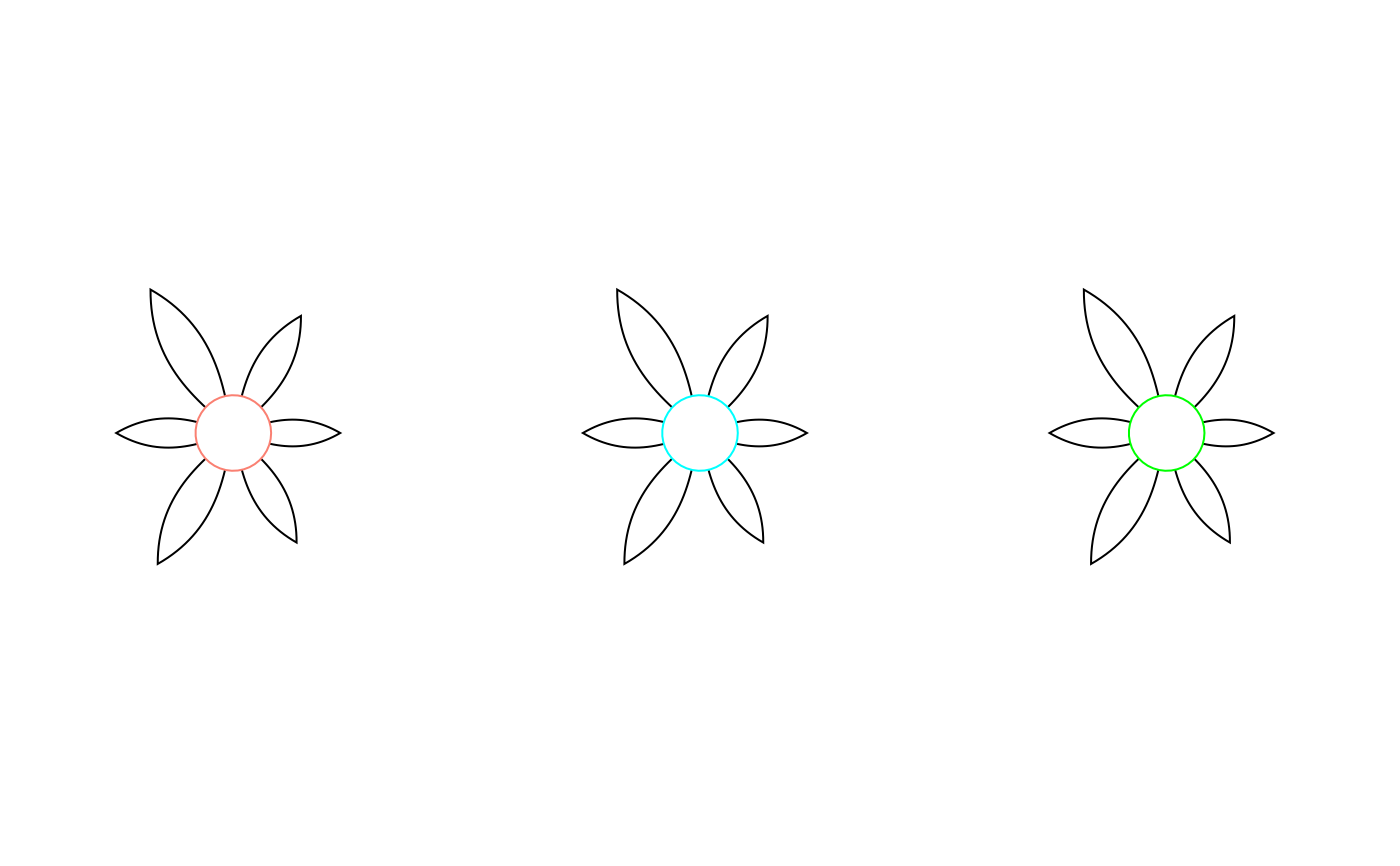 fg1 <- flowerglyphGrob(x = unit(0.5, "npc"), y = unit(0.5, "npc"),
z = z,
size = 20,
petal.base.shape = 1.25, petal.tip.shape = 1,
petal.width = 0.25,
scale.area = FALSE, scale.length = TRUE,
centre.size = 5,
col.centre = "salmon", fill.centre = "white")
fg2 <- flowerglyphGrob(x = unit(0.5, "npc"), y = unit(0.5, "npc"),
z = z,
size = 20,
petal.base.shape = 1.25, petal.tip.shape = 1,
petal.width = 0.25,
scale.area = FALSE, scale.length = TRUE,
centre.size = 5,
col.centre = "cyan", fill.centre = "white")
fg3 <- flowerglyphGrob(x = unit(0.5, "npc"), y = unit(0.5, "npc"),
z = z,
size = 20,
petal.base.shape = 1.25, petal.tip.shape = 1,
petal.width = 0.25,
scale.area = FALSE, scale.length = TRUE,
centre.size = 5,
col.centre = "green", fill.centre = "white")
grid.arrange(fg1, fg2, fg3, nrow = 1)
fg1 <- flowerglyphGrob(x = unit(0.5, "npc"), y = unit(0.5, "npc"),
z = z,
size = 20,
petal.base.shape = 1.25, petal.tip.shape = 1,
petal.width = 0.25,
scale.area = FALSE, scale.length = TRUE,
centre.size = 5,
col.centre = "salmon", fill.centre = "white")
fg2 <- flowerglyphGrob(x = unit(0.5, "npc"), y = unit(0.5, "npc"),
z = z,
size = 20,
petal.base.shape = 1.25, petal.tip.shape = 1,
petal.width = 0.25,
scale.area = FALSE, scale.length = TRUE,
centre.size = 5,
col.centre = "cyan", fill.centre = "white")
fg3 <- flowerglyphGrob(x = unit(0.5, "npc"), y = unit(0.5, "npc"),
z = z,
size = 20,
petal.base.shape = 1.25, petal.tip.shape = 1,
petal.width = 0.25,
scale.area = FALSE, scale.length = TRUE,
centre.size = 5,
col.centre = "green", fill.centre = "white")
grid.arrange(fg1, fg2, fg3, nrow = 1)
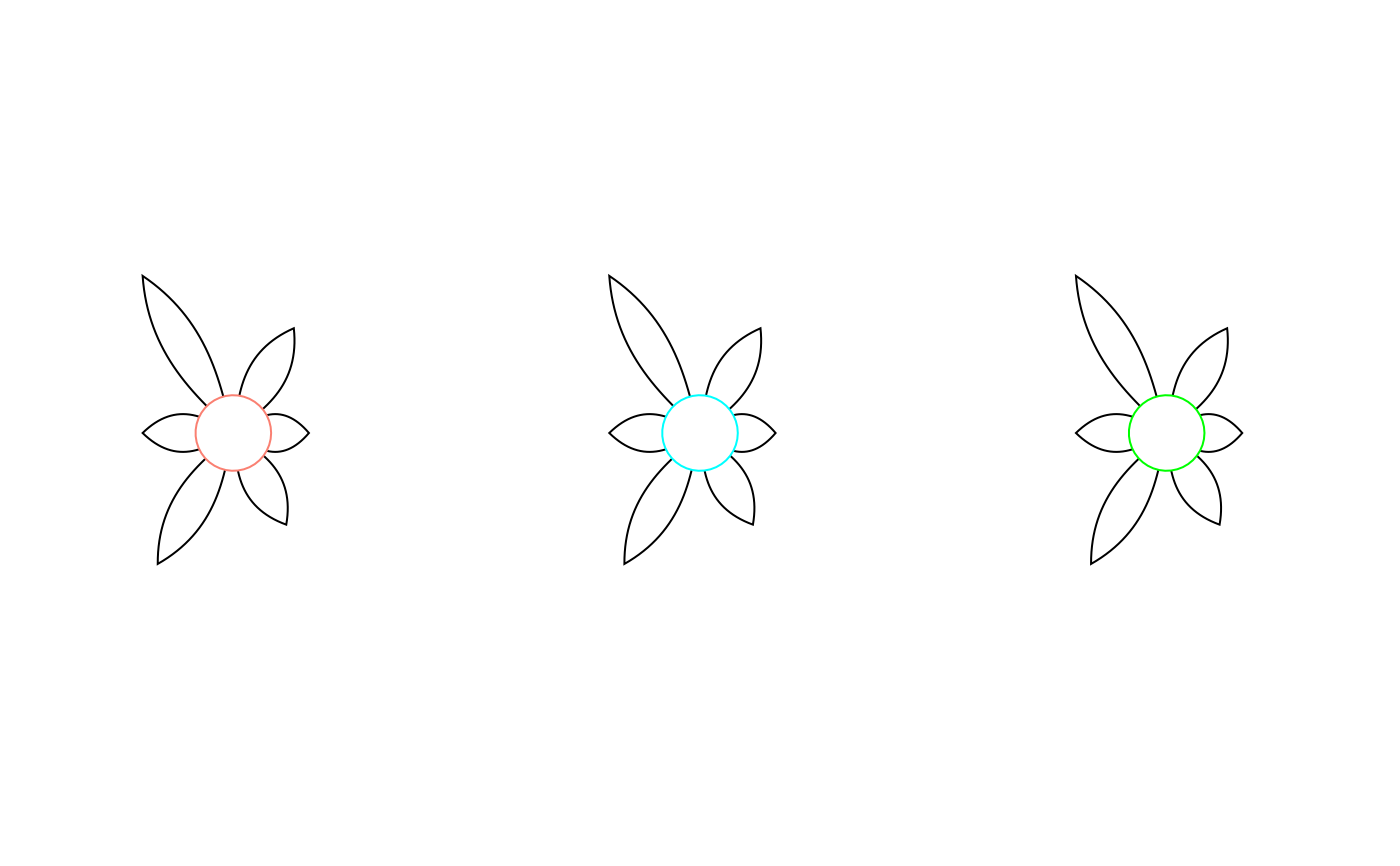 fg1 <- flowerglyphGrob(x = unit(0.5, "npc"), y = unit(0.5, "npc"),
z = z,
size = 20,
petal.base.shape = 1.25, petal.tip.shape = 1,
petal.width = 0.25,
scale.area = FALSE, scale.length = FALSE,
centre.size = 5,
col.centre = "salmon", fill.centre = "white")
fg2 <- flowerglyphGrob(x = unit(0.5, "npc"), y = unit(0.5, "npc"),
z = z,
size = 20,
petal.base.shape = 1.25, petal.tip.shape = 1,
petal.width = 0.25,
scale.area = FALSE, scale.length = FALSE,
centre.size = 5,
col.centre = "cyan", fill.centre = "white")
fg3 <- flowerglyphGrob(x = unit(0.5, "npc"), y = unit(0.5, "npc"),
z = z,
size = 20,
petal.base.shape = 1.25, petal.tip.shape = 1,
petal.width = 0.25,
scale.area = FALSE, scale.length = FALSE,
centre.size = 5,
col.centre = "green", fill.centre = "white")
grid.arrange(fg1, fg2, fg3, nrow = 1)
fg1 <- flowerglyphGrob(x = unit(0.5, "npc"), y = unit(0.5, "npc"),
z = z,
size = 20,
petal.base.shape = 1.25, petal.tip.shape = 1,
petal.width = 0.25,
scale.area = FALSE, scale.length = FALSE,
centre.size = 5,
col.centre = "salmon", fill.centre = "white")
fg2 <- flowerglyphGrob(x = unit(0.5, "npc"), y = unit(0.5, "npc"),
z = z,
size = 20,
petal.base.shape = 1.25, petal.tip.shape = 1,
petal.width = 0.25,
scale.area = FALSE, scale.length = FALSE,
centre.size = 5,
col.centre = "cyan", fill.centre = "white")
fg3 <- flowerglyphGrob(x = unit(0.5, "npc"), y = unit(0.5, "npc"),
z = z,
size = 20,
petal.base.shape = 1.25, petal.tip.shape = 1,
petal.width = 0.25,
scale.area = FALSE, scale.length = FALSE,
centre.size = 5,
col.centre = "green", fill.centre = "white")
grid.arrange(fg1, fg2, fg3, nrow = 1)
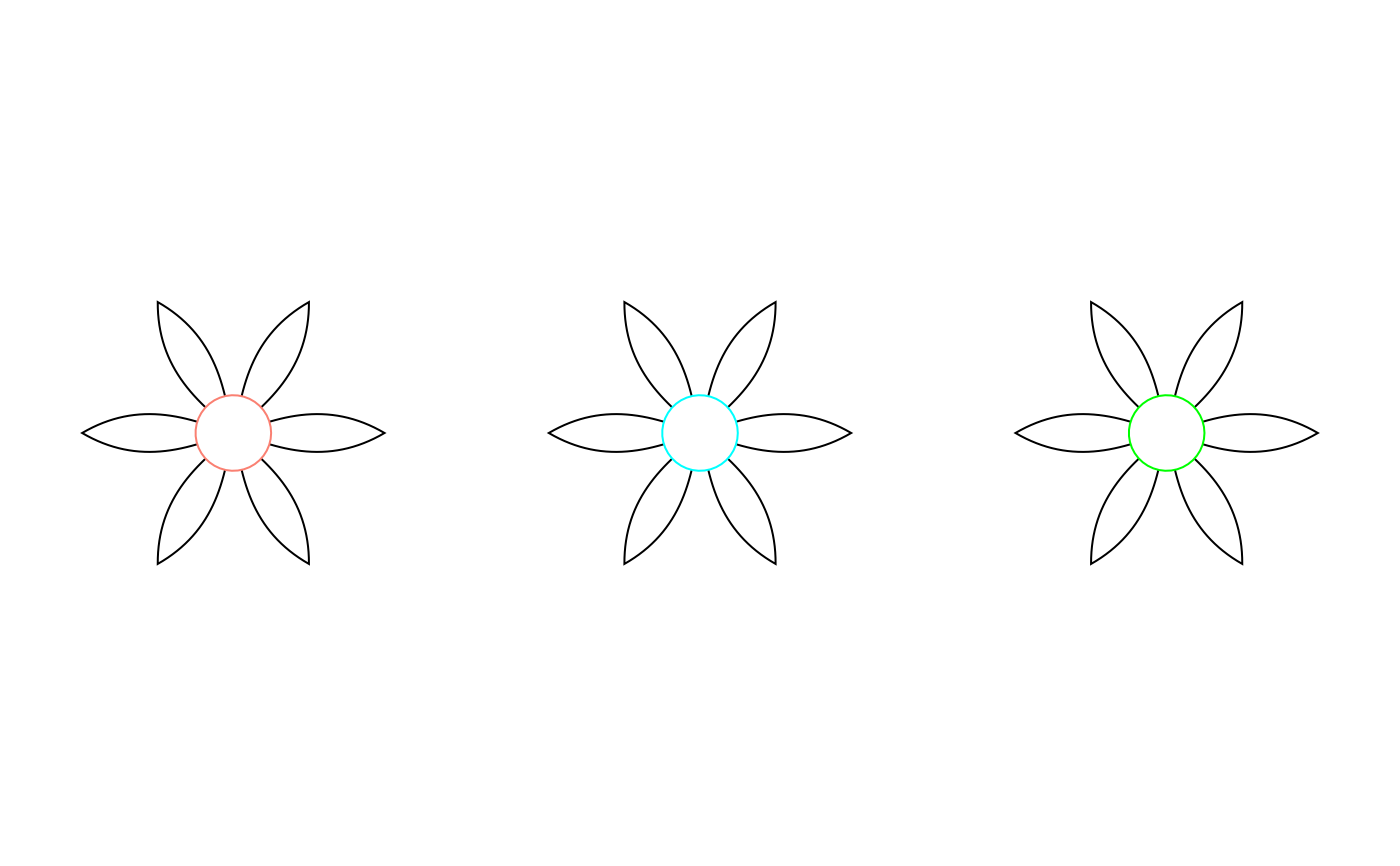 fg1 <- flowerglyphGrob(x = unit(0.5, "npc"), y = unit(0.5, "npc"),
z = z,
size = 20,
petal.base.shape = 1.25, petal.tip.shape = 1,
petal.width = 0.25,
scale.area = TRUE, scale.length = FALSE,
centre.size = 5,
fill.centre = "salmon")
fg2 <- flowerglyphGrob(x = unit(0.5, "npc"), y = unit(0.5, "npc"),
z = z,
size = 20,
petal.base.shape = 1.25, petal.tip.shape = 1,
petal.width = 0.25,
scale.area = TRUE, scale.length = FALSE,
centre.size = 5,
fill.centre = "cyan")
fg3 <- flowerglyphGrob(x = unit(0.5, "npc"), y = unit(0.5, "npc"),
z = z,
size = 20,
petal.base.shape = 1.25, petal.tip.shape = 1,
petal.width = 0.25,
scale.area = TRUE, scale.length = FALSE,
centre.size = 5,
fill.centre = "green")
grid.arrange(fg1, fg2, fg3, nrow = 1)
fg1 <- flowerglyphGrob(x = unit(0.5, "npc"), y = unit(0.5, "npc"),
z = z,
size = 20,
petal.base.shape = 1.25, petal.tip.shape = 1,
petal.width = 0.25,
scale.area = TRUE, scale.length = FALSE,
centre.size = 5,
fill.centre = "salmon")
fg2 <- flowerglyphGrob(x = unit(0.5, "npc"), y = unit(0.5, "npc"),
z = z,
size = 20,
petal.base.shape = 1.25, petal.tip.shape = 1,
petal.width = 0.25,
scale.area = TRUE, scale.length = FALSE,
centre.size = 5,
fill.centre = "cyan")
fg3 <- flowerglyphGrob(x = unit(0.5, "npc"), y = unit(0.5, "npc"),
z = z,
size = 20,
petal.base.shape = 1.25, petal.tip.shape = 1,
petal.width = 0.25,
scale.area = TRUE, scale.length = FALSE,
centre.size = 5,
fill.centre = "green")
grid.arrange(fg1, fg2, fg3, nrow = 1)
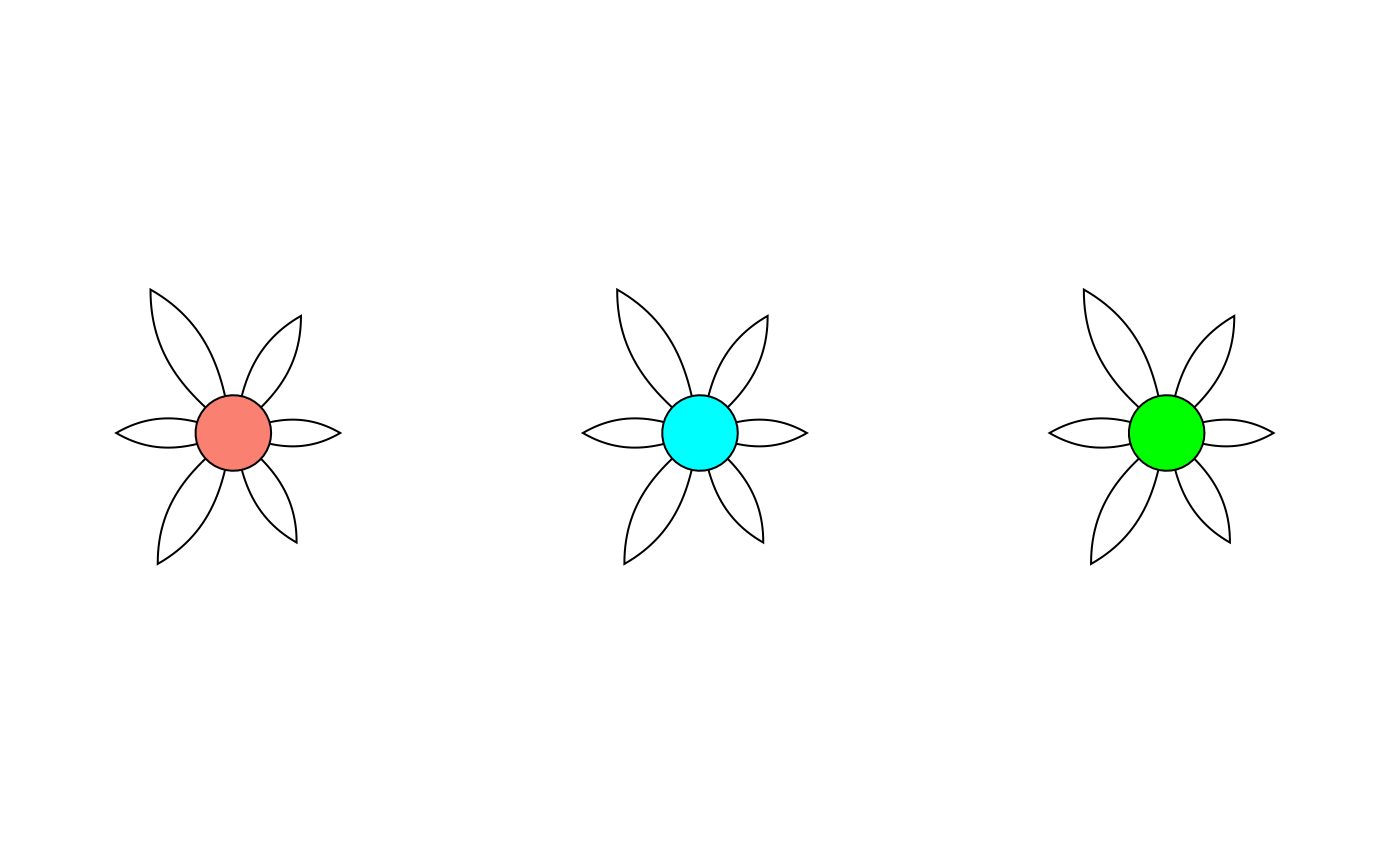 fg1 <- flowerglyphGrob(x = unit(0.5, "npc"), y = unit(0.5, "npc"),
z = z,
size = 20,
petal.base.shape = 1.25, petal.tip.shape = 1,
petal.width = 0.25,
scale.area = FALSE, scale.length = TRUE,
centre.size = 5,
fill.centre = "salmon")
fg2 <- flowerglyphGrob(x = unit(0.5, "npc"), y = unit(0.5, "npc"),
z = z,
size = 20,
petal.base.shape = 1.25, petal.tip.shape = 1,
petal.width = 0.25,
scale.area = FALSE, scale.length = TRUE,
centre.size = 5,
fill.centre = "cyan")
fg3 <- flowerglyphGrob(x = unit(0.5, "npc"), y = unit(0.5, "npc"),
z = z,
size = 20,
petal.base.shape = 1.25, petal.tip.shape = 1,
petal.width = 0.25,
scale.area = FALSE, scale.length = TRUE,
centre.size = 5,
fill.centre = "green")
grid.arrange(fg1, fg2, fg3, nrow = 1)
fg1 <- flowerglyphGrob(x = unit(0.5, "npc"), y = unit(0.5, "npc"),
z = z,
size = 20,
petal.base.shape = 1.25, petal.tip.shape = 1,
petal.width = 0.25,
scale.area = FALSE, scale.length = TRUE,
centre.size = 5,
fill.centre = "salmon")
fg2 <- flowerglyphGrob(x = unit(0.5, "npc"), y = unit(0.5, "npc"),
z = z,
size = 20,
petal.base.shape = 1.25, petal.tip.shape = 1,
petal.width = 0.25,
scale.area = FALSE, scale.length = TRUE,
centre.size = 5,
fill.centre = "cyan")
fg3 <- flowerglyphGrob(x = unit(0.5, "npc"), y = unit(0.5, "npc"),
z = z,
size = 20,
petal.base.shape = 1.25, petal.tip.shape = 1,
petal.width = 0.25,
scale.area = FALSE, scale.length = TRUE,
centre.size = 5,
fill.centre = "green")
grid.arrange(fg1, fg2, fg3, nrow = 1)
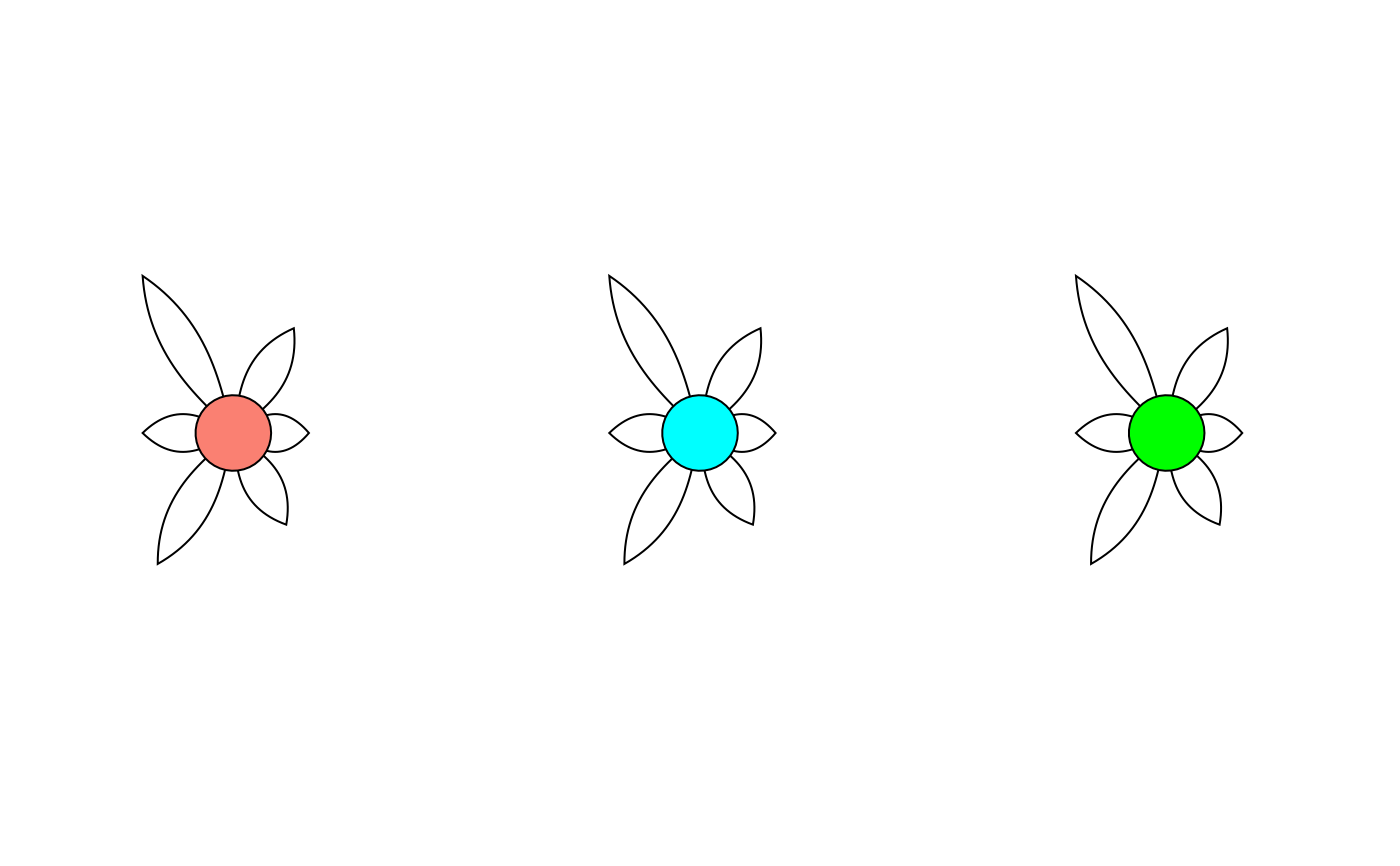 fg1 <- flowerglyphGrob(x = unit(0.5, "npc"), y = unit(0.5, "npc"),
z = z,
size = 20,
petal.base.shape = 1.25, petal.tip.shape = 1,
petal.width = 0.25,
scale.area = FALSE, scale.length = FALSE,
centre.size = 5,
fill.centre = "salmon")
fg2 <- flowerglyphGrob(x = unit(0.5, "npc"), y = unit(0.5, "npc"),
z = z,
size = 20,
petal.base.shape = 1.25, petal.tip.shape = 1,
petal.width = 0.25,
scale.area = FALSE, scale.length = FALSE,
centre.size = 5,
fill.centre = "cyan")
fg3 <- flowerglyphGrob(x = unit(0.5, "npc"), y = unit(0.5, "npc"),
z = z,
size = 20,
petal.base.shape = 1.25, petal.tip.shape = 1,
petal.width = 0.25,
scale.area = FALSE, scale.length = FALSE,
centre.size = 5,
fill.centre = "green")
grid.arrange(fg1, fg2, fg3, nrow = 1)
fg1 <- flowerglyphGrob(x = unit(0.5, "npc"), y = unit(0.5, "npc"),
z = z,
size = 20,
petal.base.shape = 1.25, petal.tip.shape = 1,
petal.width = 0.25,
scale.area = FALSE, scale.length = FALSE,
centre.size = 5,
fill.centre = "salmon")
fg2 <- flowerglyphGrob(x = unit(0.5, "npc"), y = unit(0.5, "npc"),
z = z,
size = 20,
petal.base.shape = 1.25, petal.tip.shape = 1,
petal.width = 0.25,
scale.area = FALSE, scale.length = FALSE,
centre.size = 5,
fill.centre = "cyan")
fg3 <- flowerglyphGrob(x = unit(0.5, "npc"), y = unit(0.5, "npc"),
z = z,
size = 20,
petal.base.shape = 1.25, petal.tip.shape = 1,
petal.width = 0.25,
scale.area = FALSE, scale.length = FALSE,
centre.size = 5,
fill.centre = "green")
grid.arrange(fg1, fg2, fg3, nrow = 1)
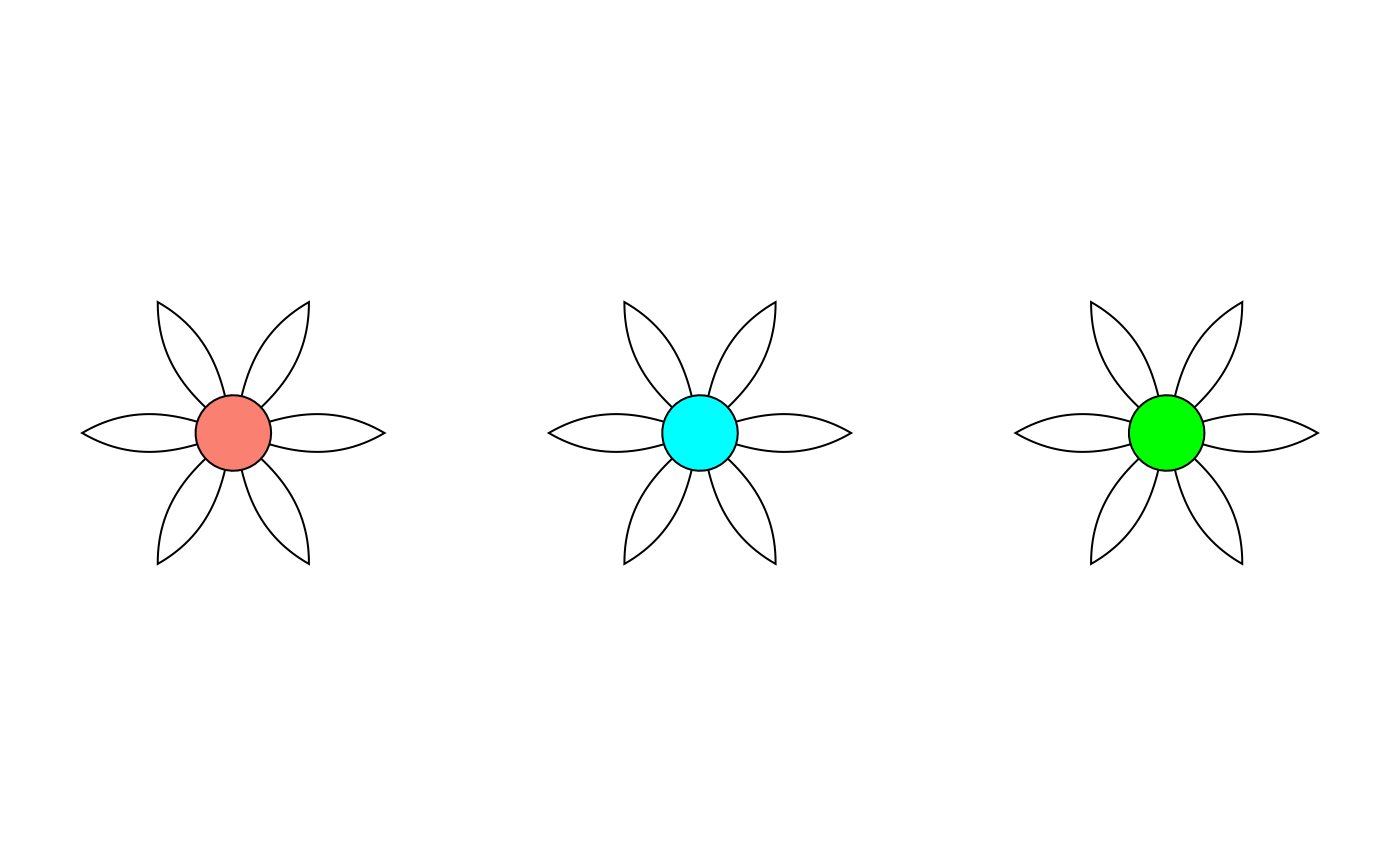 #~~~~~~~~~~~~~~~~~~~~~~~~~~~~~~~~~~~~~~~~~~~~~~~~~~~~~~~~~~~~~~~~~~~~~~~~~~~~
# Adjust petal colour and fill
#~~~~~~~~~~~~~~~~~~~~~~~~~~~~~~~~~~~~~~~~~~~~~~~~~~~~~~~~~~~~~~~~~~~~~~~~~~~~
fg1 <- flowerglyphGrob(x = unit(0.5, "npc"), y = unit(0.5, "npc"),
z = z,
size = 20,
petal.base.shape = 1.25, petal.tip.shape = 1,
petal.width = 0.25,
scale.area = TRUE, scale.length = FALSE,
col = "salmon")
fg2 <- flowerglyphGrob(x = unit(0.5, "npc"), y = unit(0.5, "npc"),
z = z,
size = 20,
petal.base.shape = 1.25, petal.tip.shape = 1,
petal.width = 0.25,
scale.area = TRUE, scale.length = FALSE,
col = "cyan")
fg3 <- flowerglyphGrob(x = unit(0.5, "npc"), y = unit(0.5, "npc"),
z = z,
size = 20,
petal.base.shape = 1.25, petal.tip.shape = 1,
petal.width = 0.25,
scale.area = TRUE, scale.length = FALSE,
col = "green")
grid.arrange(fg1, fg2, fg3, nrow = 1)
#~~~~~~~~~~~~~~~~~~~~~~~~~~~~~~~~~~~~~~~~~~~~~~~~~~~~~~~~~~~~~~~~~~~~~~~~~~~~
# Adjust petal colour and fill
#~~~~~~~~~~~~~~~~~~~~~~~~~~~~~~~~~~~~~~~~~~~~~~~~~~~~~~~~~~~~~~~~~~~~~~~~~~~~
fg1 <- flowerglyphGrob(x = unit(0.5, "npc"), y = unit(0.5, "npc"),
z = z,
size = 20,
petal.base.shape = 1.25, petal.tip.shape = 1,
petal.width = 0.25,
scale.area = TRUE, scale.length = FALSE,
col = "salmon")
fg2 <- flowerglyphGrob(x = unit(0.5, "npc"), y = unit(0.5, "npc"),
z = z,
size = 20,
petal.base.shape = 1.25, petal.tip.shape = 1,
petal.width = 0.25,
scale.area = TRUE, scale.length = FALSE,
col = "cyan")
fg3 <- flowerglyphGrob(x = unit(0.5, "npc"), y = unit(0.5, "npc"),
z = z,
size = 20,
petal.base.shape = 1.25, petal.tip.shape = 1,
petal.width = 0.25,
scale.area = TRUE, scale.length = FALSE,
col = "green")
grid.arrange(fg1, fg2, fg3, nrow = 1)
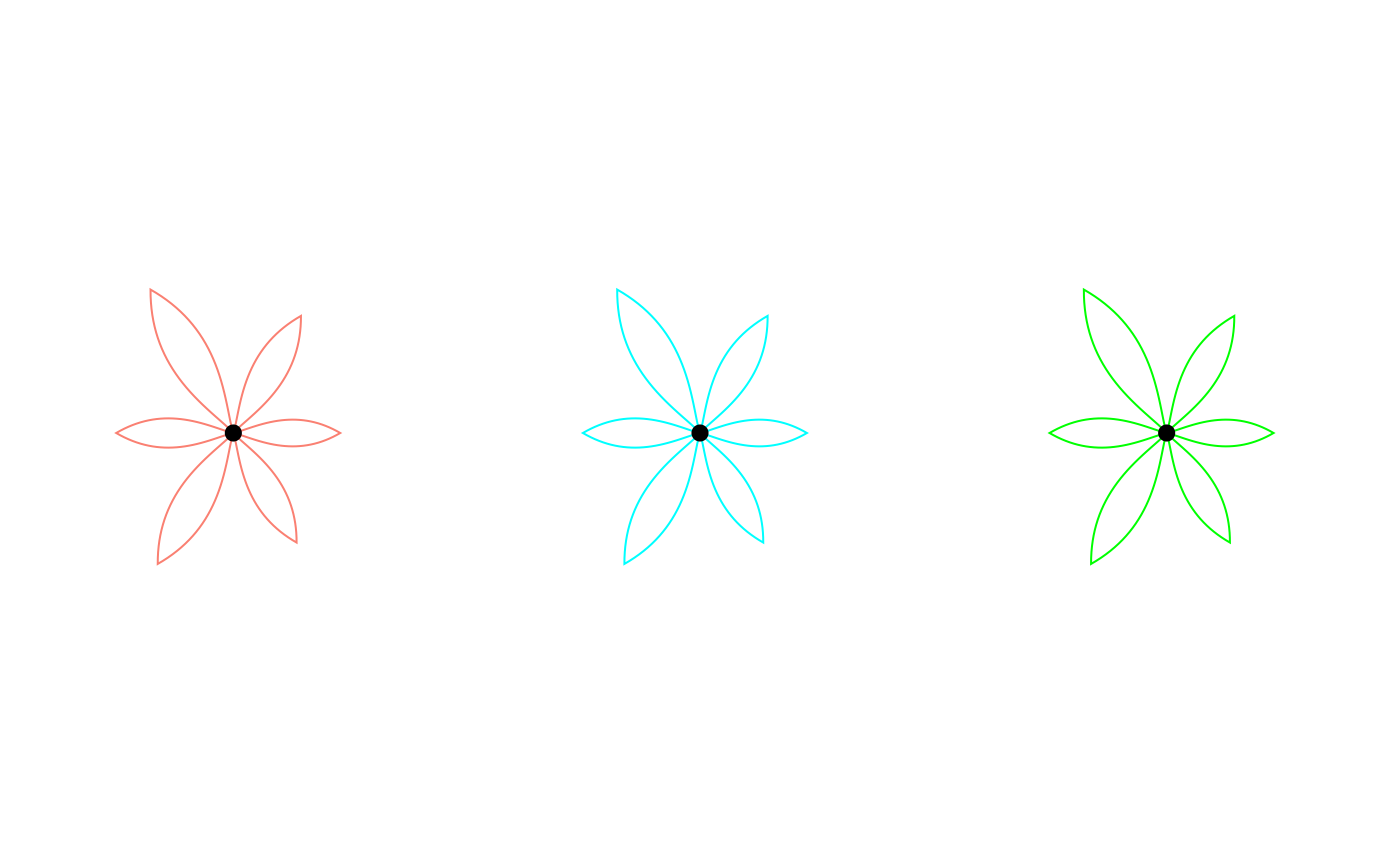 fg1 <- flowerglyphGrob(x = unit(0.5, "npc"), y = unit(0.5, "npc"),
z = z,
size = 20,
petal.base.shape = 1.25, petal.tip.shape = 1,
petal.width = 0.25,
scale.area = FALSE, scale.length = TRUE,
col = "salmon")
fg2 <- flowerglyphGrob(x = unit(0.5, "npc"), y = unit(0.5, "npc"),
z = z,
size = 20,
petal.base.shape = 1.25, petal.tip.shape = 1,
petal.width = 0.25,
scale.area = FALSE, scale.length = TRUE,
col = "cyan")
fg3 <- flowerglyphGrob(x = unit(0.5, "npc"), y = unit(0.5, "npc"),
z = z,
size = 20,
petal.base.shape = 1.25, petal.tip.shape = 1,
petal.width = 0.25,
scale.area = FALSE, scale.length = TRUE,
col = "green")
grid.arrange(fg1, fg2, fg3, nrow = 1)
fg1 <- flowerglyphGrob(x = unit(0.5, "npc"), y = unit(0.5, "npc"),
z = z,
size = 20,
petal.base.shape = 1.25, petal.tip.shape = 1,
petal.width = 0.25,
scale.area = FALSE, scale.length = TRUE,
col = "salmon")
fg2 <- flowerglyphGrob(x = unit(0.5, "npc"), y = unit(0.5, "npc"),
z = z,
size = 20,
petal.base.shape = 1.25, petal.tip.shape = 1,
petal.width = 0.25,
scale.area = FALSE, scale.length = TRUE,
col = "cyan")
fg3 <- flowerglyphGrob(x = unit(0.5, "npc"), y = unit(0.5, "npc"),
z = z,
size = 20,
petal.base.shape = 1.25, petal.tip.shape = 1,
petal.width = 0.25,
scale.area = FALSE, scale.length = TRUE,
col = "green")
grid.arrange(fg1, fg2, fg3, nrow = 1)
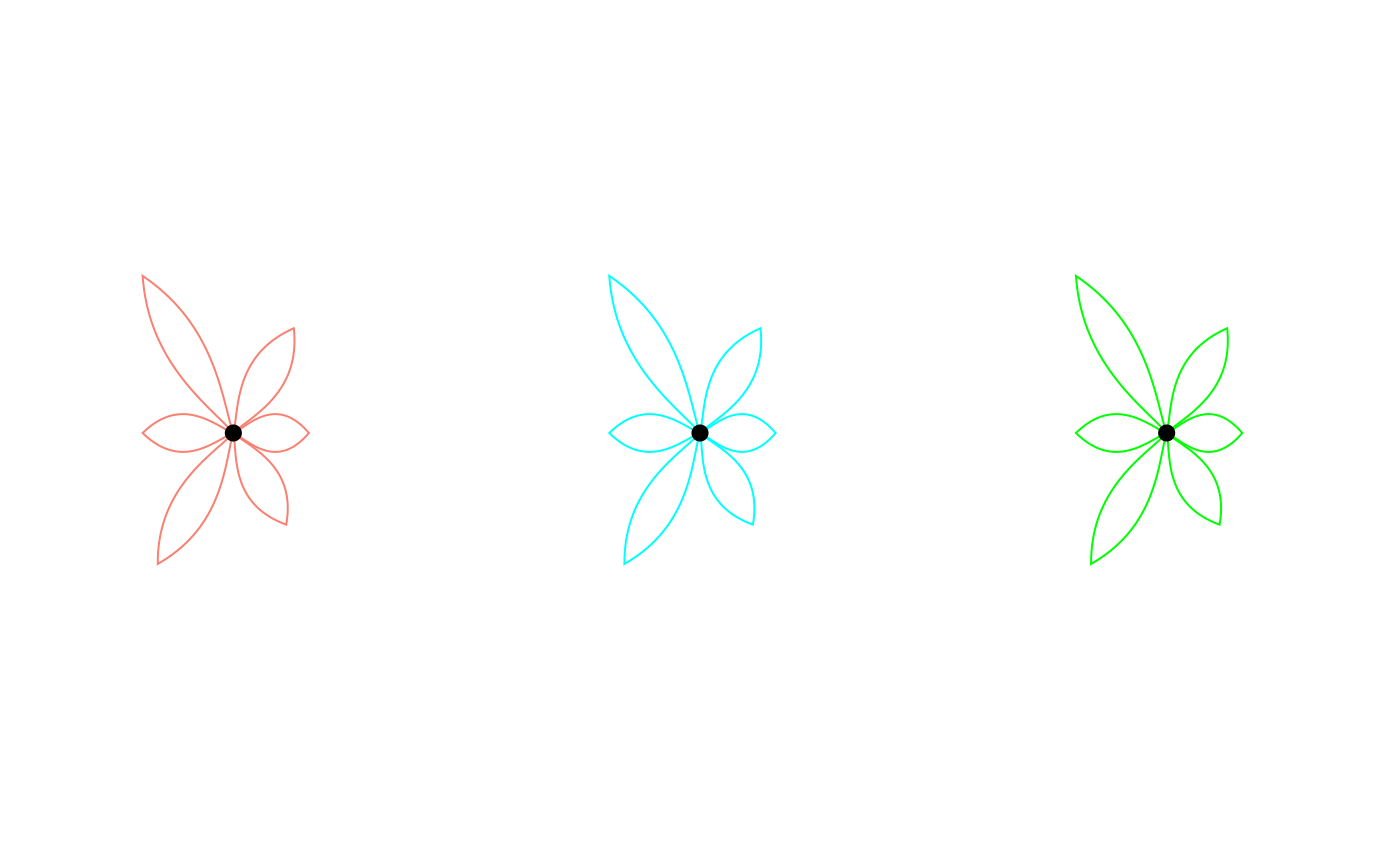 fg1 <- flowerglyphGrob(x = unit(0.5, "npc"), y = unit(0.5, "npc"),
z = z,
size = 20,
petal.base.shape = 1.25, petal.tip.shape = 1,
petal.width = 0.25,
scale.area = FALSE, scale.length = FALSE,
col = "salmon")
fg2 <- flowerglyphGrob(x = unit(0.5, "npc"), y = unit(0.5, "npc"),
z = z,
size = 20,
petal.base.shape = 1.25, petal.tip.shape = 1,
petal.width = 0.25,
scale.area = FALSE, scale.length = FALSE,
col = "cyan")
fg3 <- flowerglyphGrob(x = unit(0.5, "npc"), y = unit(0.5, "npc"),
z = z,
size = 20,
petal.base.shape = 1.25, petal.tip.shape = 1,
petal.width = 0.25,
scale.area = FALSE, scale.length = FALSE,
col = "green")
grid.arrange(fg1, fg2, fg3, nrow = 1)
fg1 <- flowerglyphGrob(x = unit(0.5, "npc"), y = unit(0.5, "npc"),
z = z,
size = 20,
petal.base.shape = 1.25, petal.tip.shape = 1,
petal.width = 0.25,
scale.area = FALSE, scale.length = FALSE,
col = "salmon")
fg2 <- flowerglyphGrob(x = unit(0.5, "npc"), y = unit(0.5, "npc"),
z = z,
size = 20,
petal.base.shape = 1.25, petal.tip.shape = 1,
petal.width = 0.25,
scale.area = FALSE, scale.length = FALSE,
col = "cyan")
fg3 <- flowerglyphGrob(x = unit(0.5, "npc"), y = unit(0.5, "npc"),
z = z,
size = 20,
petal.base.shape = 1.25, petal.tip.shape = 1,
petal.width = 0.25,
scale.area = FALSE, scale.length = FALSE,
col = "green")
grid.arrange(fg1, fg2, fg3, nrow = 1)
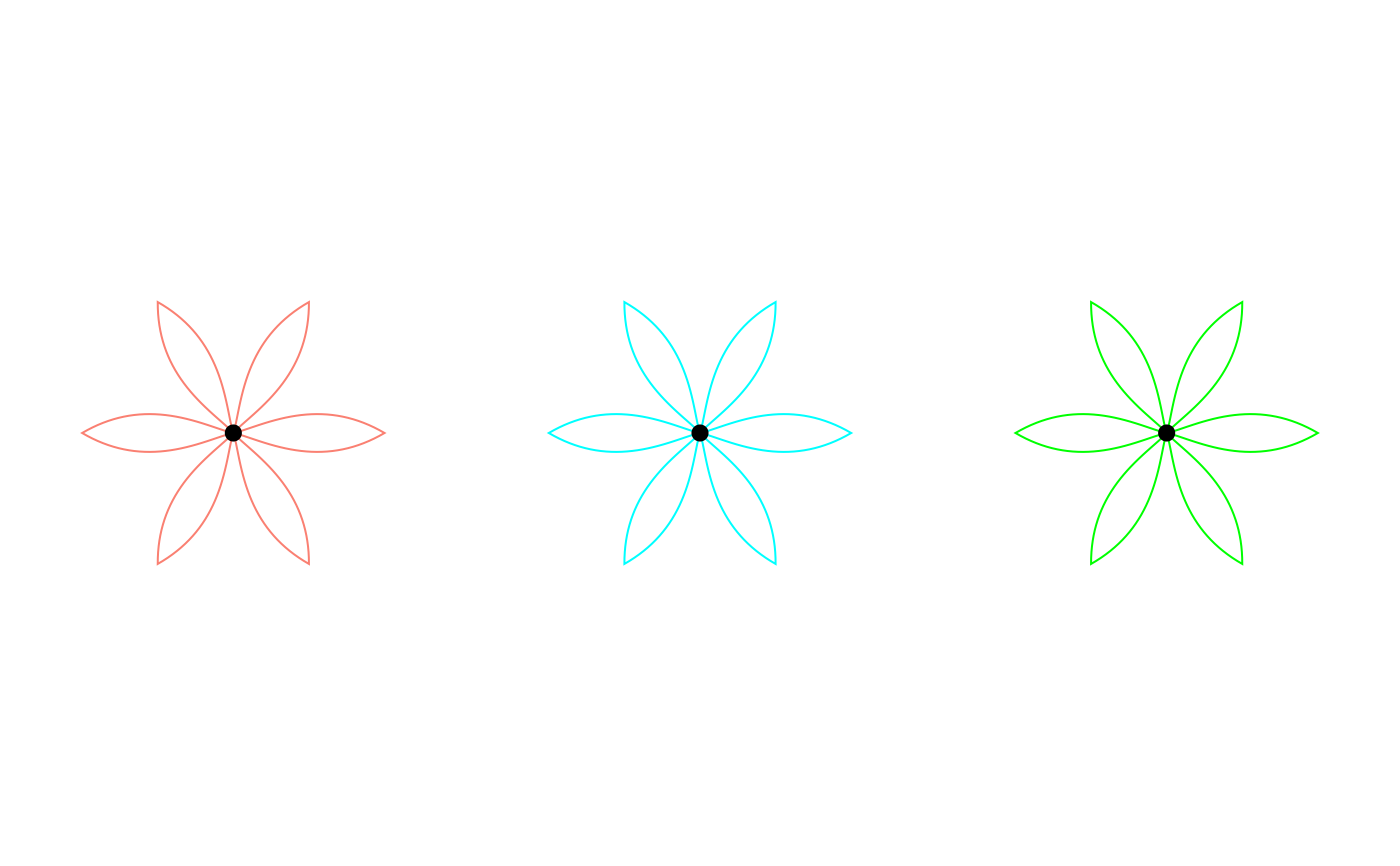 fg1 <- flowerglyphGrob(x = unit(0.5, "npc"), y = unit(0.5, "npc"),
z = z,
size = 20,
petal.base.shape = 1.25, petal.tip.shape = 1,
petal.width = 0.25,
scale.area = TRUE, scale.length = FALSE,
fill = "salmon")
fg2 <- flowerglyphGrob(x = unit(0.5, "npc"), y = unit(0.5, "npc"),
z = z,
size = 20,
petal.base.shape = 1.25, petal.tip.shape = 1,
petal.width = 0.25,
scale.area = TRUE, scale.length = FALSE,
fill = "cyan")
fg3 <- flowerglyphGrob(x = unit(0.5, "npc"), y = unit(0.5, "npc"),
z = z,
size = 20,
petal.base.shape = 1.25, petal.tip.shape = 1,
petal.width = 0.25,
scale.area = TRUE, scale.length = FALSE,
fill = "green")
grid.arrange(fg1, fg2, fg3, nrow = 1)
fg1 <- flowerglyphGrob(x = unit(0.5, "npc"), y = unit(0.5, "npc"),
z = z,
size = 20,
petal.base.shape = 1.25, petal.tip.shape = 1,
petal.width = 0.25,
scale.area = TRUE, scale.length = FALSE,
fill = "salmon")
fg2 <- flowerglyphGrob(x = unit(0.5, "npc"), y = unit(0.5, "npc"),
z = z,
size = 20,
petal.base.shape = 1.25, petal.tip.shape = 1,
petal.width = 0.25,
scale.area = TRUE, scale.length = FALSE,
fill = "cyan")
fg3 <- flowerglyphGrob(x = unit(0.5, "npc"), y = unit(0.5, "npc"),
z = z,
size = 20,
petal.base.shape = 1.25, petal.tip.shape = 1,
petal.width = 0.25,
scale.area = TRUE, scale.length = FALSE,
fill = "green")
grid.arrange(fg1, fg2, fg3, nrow = 1)
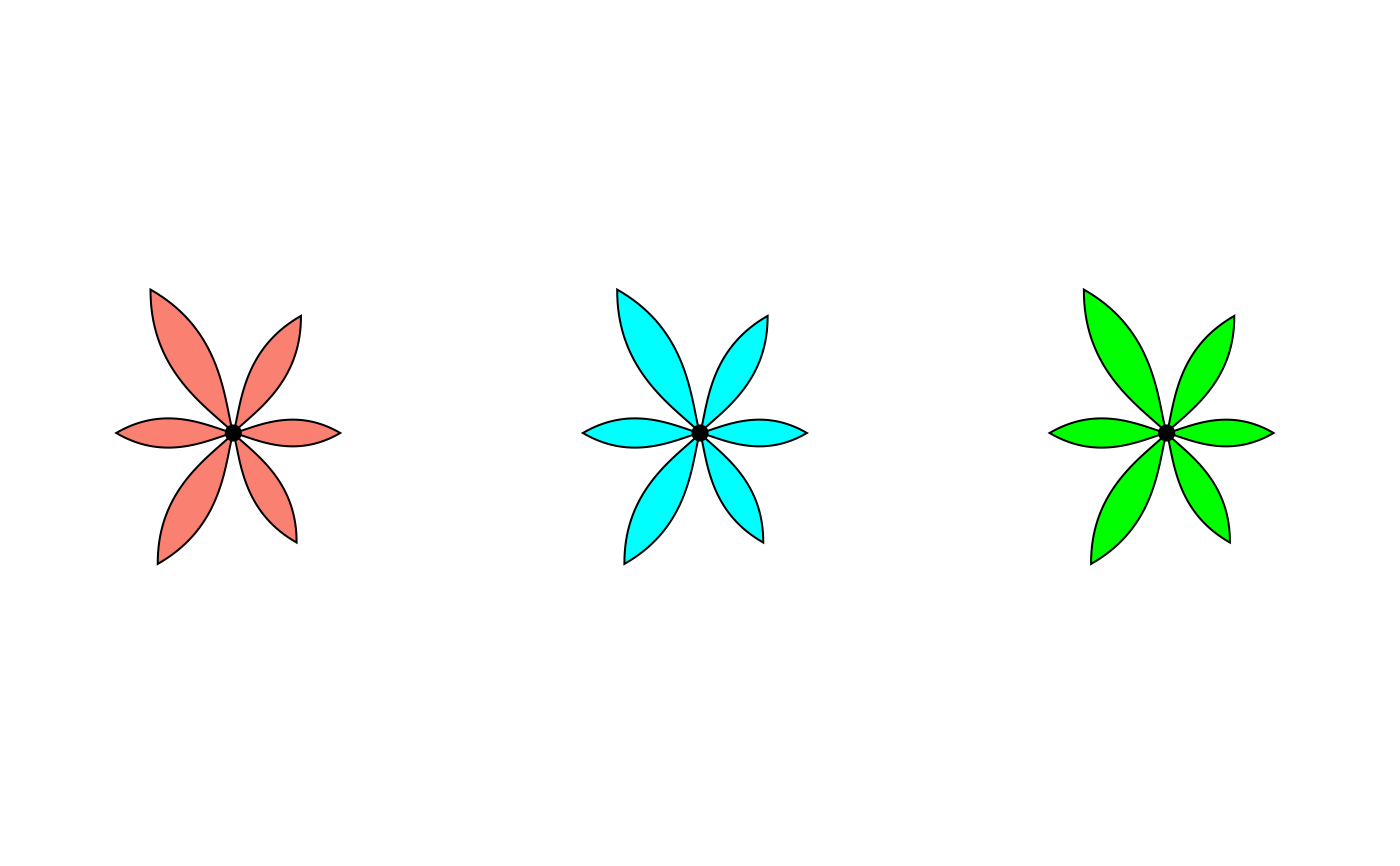 fg1 <- flowerglyphGrob(x = unit(0.5, "npc"), y = unit(0.5, "npc"),
z = z,
size = 20,
petal.base.shape = 1.25, petal.tip.shape = 1,
petal.width = 0.25,
scale.area = FALSE, scale.length = TRUE,
fill = "salmon")
fg2 <- flowerglyphGrob(x = unit(0.5, "npc"), y = unit(0.5, "npc"),
z = z,
size = 20,
petal.base.shape = 1.25, petal.tip.shape = 1,
petal.width = 0.25,
scale.area = FALSE, scale.length = TRUE,
fill = "cyan")
fg3 <- flowerglyphGrob(x = unit(0.5, "npc"), y = unit(0.5, "npc"),
z = z,
size = 20,
petal.base.shape = 1.25, petal.tip.shape = 1,
petal.width = 0.25,
scale.area = FALSE, scale.length = TRUE,
fill = "green")
grid.arrange(fg1, fg2, fg3, nrow = 1)
fg1 <- flowerglyphGrob(x = unit(0.5, "npc"), y = unit(0.5, "npc"),
z = z,
size = 20,
petal.base.shape = 1.25, petal.tip.shape = 1,
petal.width = 0.25,
scale.area = FALSE, scale.length = TRUE,
fill = "salmon")
fg2 <- flowerglyphGrob(x = unit(0.5, "npc"), y = unit(0.5, "npc"),
z = z,
size = 20,
petal.base.shape = 1.25, petal.tip.shape = 1,
petal.width = 0.25,
scale.area = FALSE, scale.length = TRUE,
fill = "cyan")
fg3 <- flowerglyphGrob(x = unit(0.5, "npc"), y = unit(0.5, "npc"),
z = z,
size = 20,
petal.base.shape = 1.25, petal.tip.shape = 1,
petal.width = 0.25,
scale.area = FALSE, scale.length = TRUE,
fill = "green")
grid.arrange(fg1, fg2, fg3, nrow = 1)
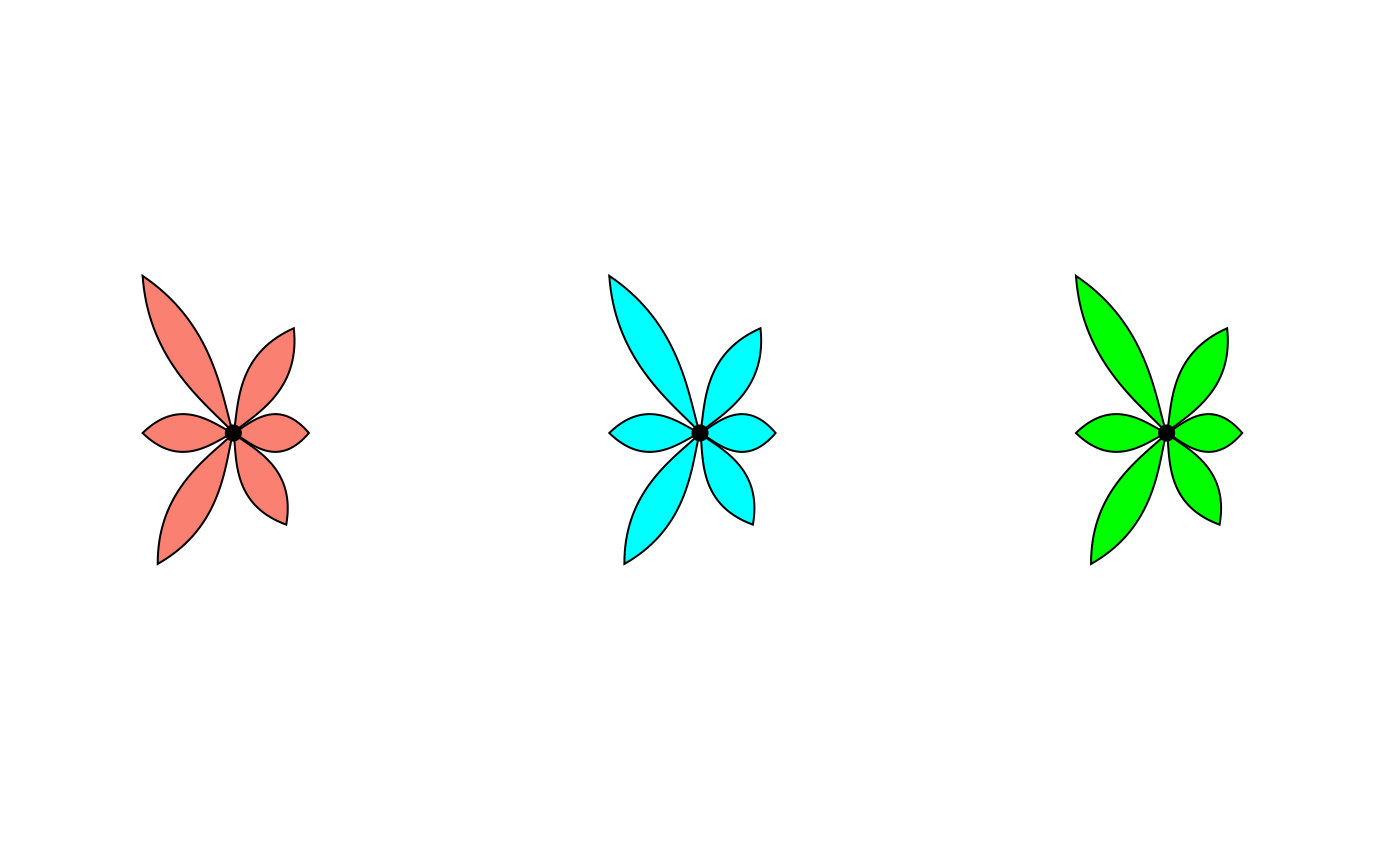 fg1 <- flowerglyphGrob(x = unit(0.5, "npc"), y = unit(0.5, "npc"),
z = z,
size = 20,
petal.base.shape = 1.25, petal.tip.shape = 1,
petal.width = 0.25,
scale.area = FALSE, scale.length = FALSE,
fill = "salmon")
fg2 <- flowerglyphGrob(x = unit(0.5, "npc"), y = unit(0.5, "npc"),
z = z,
size = 20,
petal.base.shape = 1.25, petal.tip.shape = 1,
petal.width = 0.25,
scale.area = FALSE, scale.length = FALSE,
fill = "cyan")
fg3 <- flowerglyphGrob(x = unit(0.5, "npc"), y = unit(0.5, "npc"),
z = z,
size = 20,
petal.base.shape = 1.25, petal.tip.shape = 1,
petal.width = 0.25,
scale.area = FALSE, scale.length = FALSE,
fill = "green")
grid.arrange(fg1, fg2, fg3, nrow = 1)
fg1 <- flowerglyphGrob(x = unit(0.5, "npc"), y = unit(0.5, "npc"),
z = z,
size = 20,
petal.base.shape = 1.25, petal.tip.shape = 1,
petal.width = 0.25,
scale.area = FALSE, scale.length = FALSE,
fill = "salmon")
fg2 <- flowerglyphGrob(x = unit(0.5, "npc"), y = unit(0.5, "npc"),
z = z,
size = 20,
petal.base.shape = 1.25, petal.tip.shape = 1,
petal.width = 0.25,
scale.area = FALSE, scale.length = FALSE,
fill = "cyan")
fg3 <- flowerglyphGrob(x = unit(0.5, "npc"), y = unit(0.5, "npc"),
z = z,
size = 20,
petal.base.shape = 1.25, petal.tip.shape = 1,
petal.width = 0.25,
scale.area = FALSE, scale.length = FALSE,
fill = "green")
grid.arrange(fg1, fg2, fg3, nrow = 1)
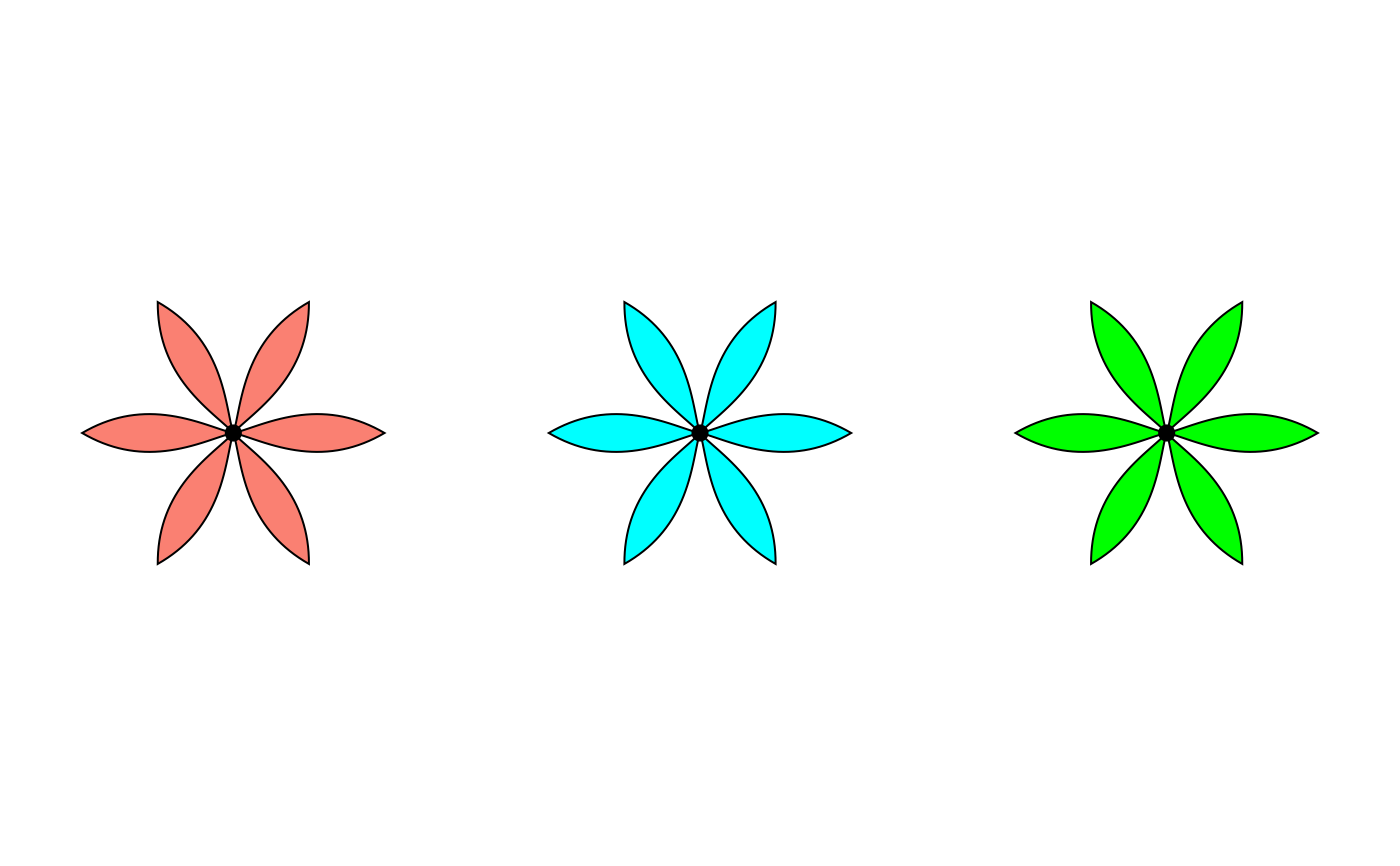 #~~~~~~~~~~~~~~~~~~~~~~~~~~~~~~~~~~~~~~~~~~~~~~~~~~~~~~~~~~~~~~~~~~~~~~~~~~~~
# Multivariate petal fill and colour
#~~~~~~~~~~~~~~~~~~~~~~~~~~~~~~~~~~~~~~~~~~~~~~~~~~~~~~~~~~~~~~~~~~~~~~~~~~~~
fg1 <- flowerglyphGrob(x = unit(0.5, "npc"), y = unit(0.5, "npc"),
z = z,
size = 20,
petal.base.shape = 1.25, petal.tip.shape = 1,
petal.width = 0.25,
scale.area = TRUE, scale.length = FALSE,
fill = RColorBrewer::brewer.pal(6, "Dark2"))
fg2 <- flowerglyphGrob(x = unit(0.5, "npc"), y = unit(0.5, "npc"),
z = z,
size = 20,
petal.base.shape = 1.25, petal.tip.shape = 1,
petal.width = 0.25,
scale.area = FALSE, scale.length = TRUE,
fill = RColorBrewer::brewer.pal(6, "Dark2"))
fg3 <- flowerglyphGrob(x = unit(0.5, "npc"), y = unit(0.5, "npc"),
z = z,
size = 20,
petal.base.shape = 1.25, petal.tip.shape = 1,
petal.width = 0.25,
scale.area = FALSE, scale.length = FALSE,
fill = RColorBrewer::brewer.pal(6, "Dark2"))
grid.arrange(fg1, fg2, fg3, nrow = 1)
#~~~~~~~~~~~~~~~~~~~~~~~~~~~~~~~~~~~~~~~~~~~~~~~~~~~~~~~~~~~~~~~~~~~~~~~~~~~~
# Multivariate petal fill and colour
#~~~~~~~~~~~~~~~~~~~~~~~~~~~~~~~~~~~~~~~~~~~~~~~~~~~~~~~~~~~~~~~~~~~~~~~~~~~~
fg1 <- flowerglyphGrob(x = unit(0.5, "npc"), y = unit(0.5, "npc"),
z = z,
size = 20,
petal.base.shape = 1.25, petal.tip.shape = 1,
petal.width = 0.25,
scale.area = TRUE, scale.length = FALSE,
fill = RColorBrewer::brewer.pal(6, "Dark2"))
fg2 <- flowerglyphGrob(x = unit(0.5, "npc"), y = unit(0.5, "npc"),
z = z,
size = 20,
petal.base.shape = 1.25, petal.tip.shape = 1,
petal.width = 0.25,
scale.area = FALSE, scale.length = TRUE,
fill = RColorBrewer::brewer.pal(6, "Dark2"))
fg3 <- flowerglyphGrob(x = unit(0.5, "npc"), y = unit(0.5, "npc"),
z = z,
size = 20,
petal.base.shape = 1.25, petal.tip.shape = 1,
petal.width = 0.25,
scale.area = FALSE, scale.length = FALSE,
fill = RColorBrewer::brewer.pal(6, "Dark2"))
grid.arrange(fg1, fg2, fg3, nrow = 1)
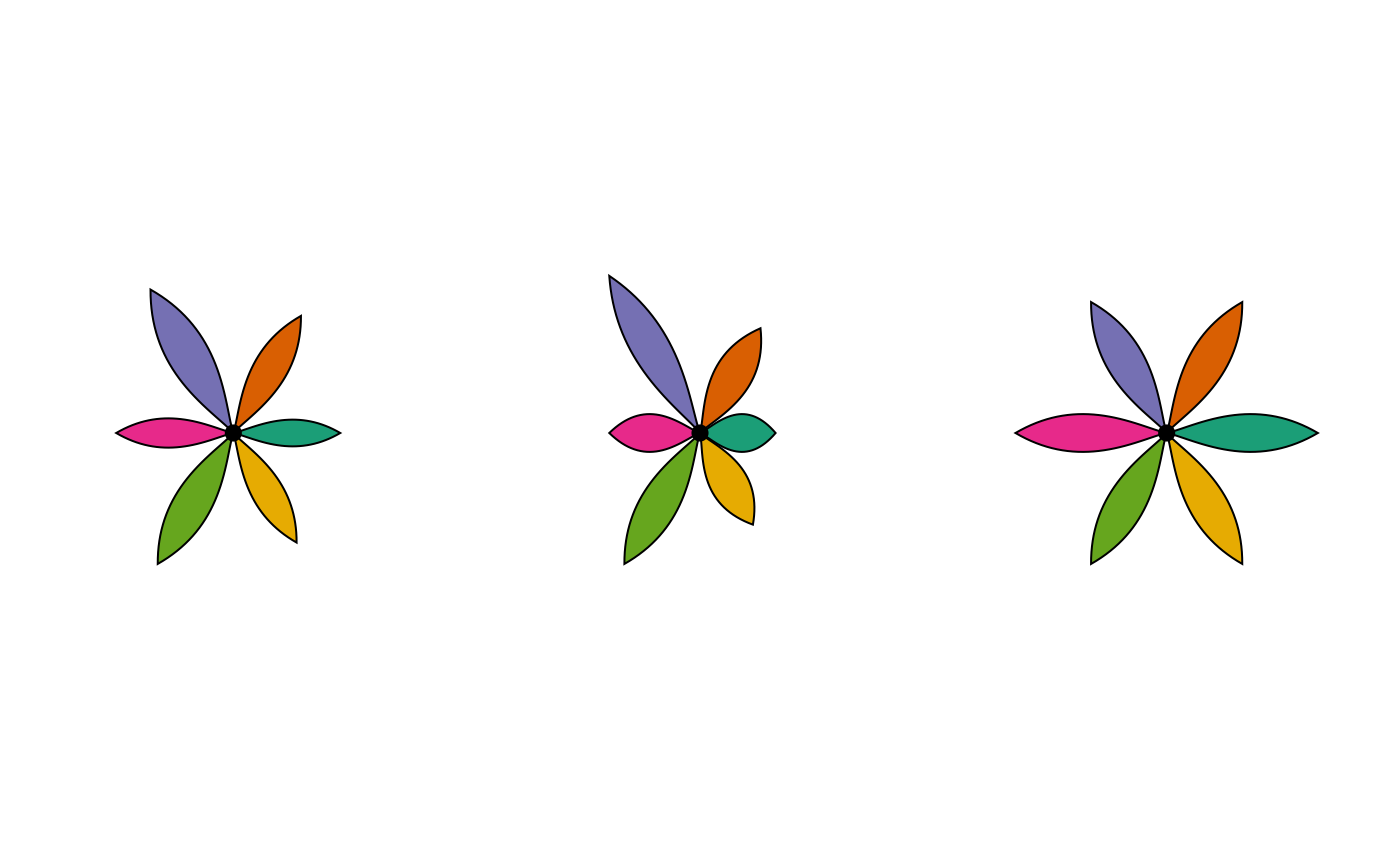 fg1 <- flowerglyphGrob(x = unit(0.5, "npc"), y = unit(0.5, "npc"),
z = z,
size = 20,
petal.base.shape = 1.25, petal.tip.shape = 1,
petal.width = 0.25, lwd = 3,
scale.area = TRUE, scale.length = FALSE,
col = RColorBrewer::brewer.pal(6, "Dark2"))
fg2 <- flowerglyphGrob(x = unit(0.5, "npc"), y = unit(0.5, "npc"),
z = z,
size = 20,
petal.base.shape = 1.25, petal.tip.shape = 1,
petal.width = 0.25, lwd = 3,
scale.area = FALSE, scale.length = TRUE,
col = RColorBrewer::brewer.pal(6, "Dark2"))
fg3 <- flowerglyphGrob(x = unit(0.5, "npc"), y = unit(0.5, "npc"),
z = z,
size = 20,
petal.base.shape = 1.25, petal.tip.shape = 1,
petal.width = 0.25, lwd = 3,
scale.area = FALSE, scale.length = FALSE,
col = RColorBrewer::brewer.pal(6, "Dark2"))
grid.arrange(fg1, fg2, fg3, nrow = 1)
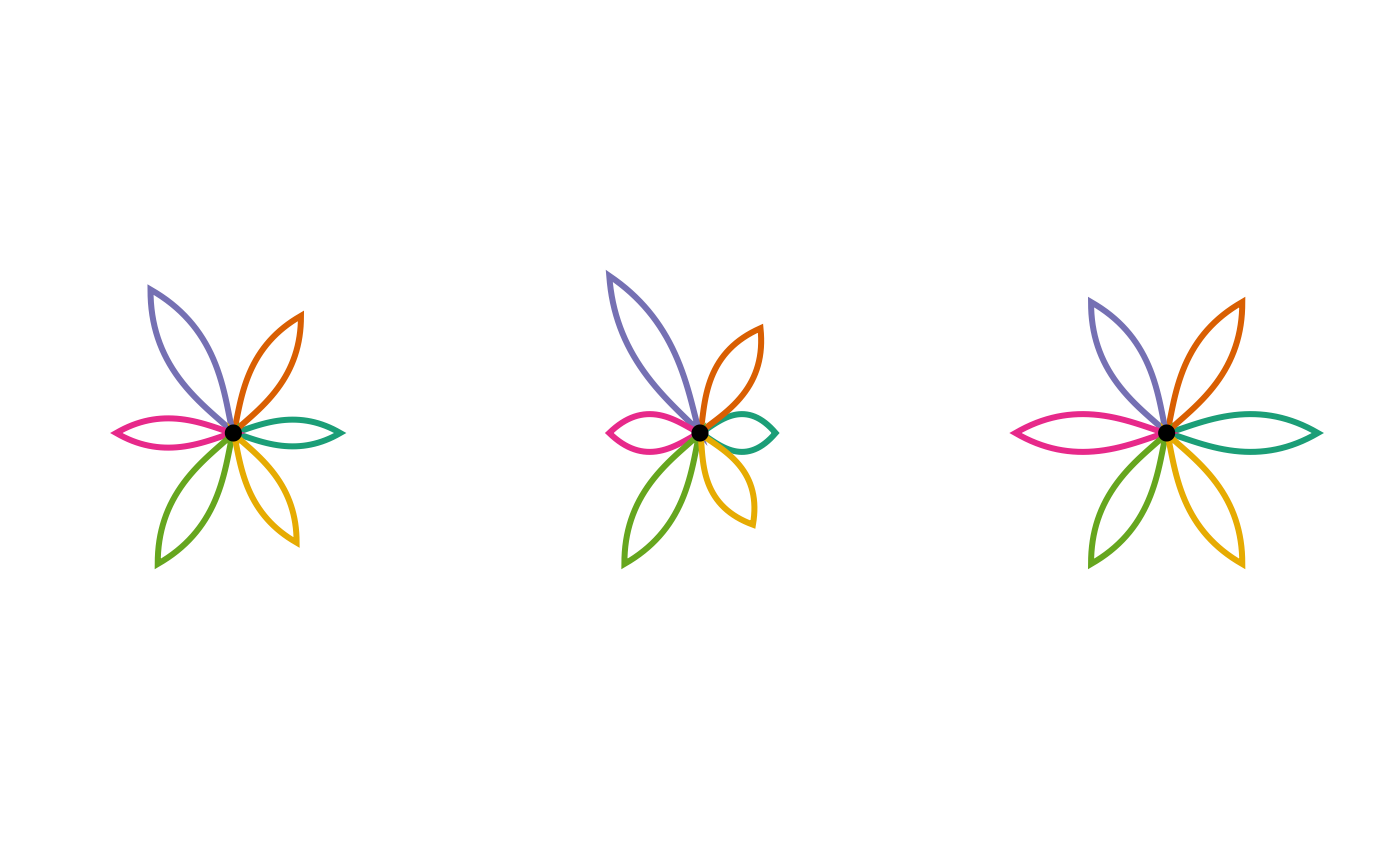
fg1 <- flowerglyphGrob(x = unit(0.5, "npc"), y = unit(0.5, "npc"),
z = z,
size = 20,
petal.base.shape = 1.25, petal.tip.shape = 1,
petal.width = 0.25, lwd = 3,
scale.area = TRUE, scale.length = FALSE,
col = RColorBrewer::brewer.pal(6, "Dark2"))
fg2 <- flowerglyphGrob(x = unit(0.5, "npc"), y = unit(0.5, "npc"),
z = z,
size = 20,
petal.base.shape = 1.25, petal.tip.shape = 1,
petal.width = 0.25, lwd = 3,
scale.area = FALSE, scale.length = TRUE,
col = RColorBrewer::brewer.pal(6, "Dark2"))
fg3 <- flowerglyphGrob(x = unit(0.5, "npc"), y = unit(0.5, "npc"),
z = z,
size = 20,
petal.base.shape = 1.25, petal.tip.shape = 1,
petal.width = 0.25, lwd = 3,
scale.area = FALSE, scale.length = FALSE,
col = RColorBrewer::brewer.pal(6, "Dark2"))
grid.arrange(fg1, fg2, fg3, nrow = 1)
 #~~~~~~~~~~~~~~~~~~~~~~~~~~~~~~~~~~~~~~~~~~~~~~~~~~~~~~~~~~~~~~~~~~~~~~~~~~~~
# Adjust grid levels
#~~~~~~~~~~~~~~~~~~~~~~~~~~~~~~~~~~~~~~~~~~~~~~~~~~~~~~~~~~~~~~~~~~~~~~~~~~~~
gl <- split(x = c(rep(c(1, 2, 3), 4),
rep(c(1, 2, 3, 4), 2)),
f = c(rep(1:4, each = 3),
rep(5:6, each = 4)))
gl
#> $`1`
#> [1] 1 2 3
#>
#> $`2`
#> [1] 1 2 3
#>
#> $`3`
#> [1] 1 2 3
#>
#> $`4`
#> [1] 1 2 3
#>
#> $`5`
#> [1] 1 2 3 4
#>
#> $`6`
#> [1] 1 2 3 4
#>
fg1 <- flowerglyphGrob(x = unit(0.5, "npc"), y = unit(0.5, "npc"),
z = c(1, 3, 2, 1, 2, 3),
size = 15,
petal.base.shape = 1.25, petal.tip.shape = 1,
petal.width = 0.25,
scale.area = TRUE, scale.length = FALSE,
draw.grid = TRUE, grid.levels = gl,
fill = "white", col.grid = "black")
fg2 <- flowerglyphGrob(x = unit(0.5, "npc"), y = unit(0.5, "npc"),
z = c(1, 3, 2, 1, 2, 3),
size = 15,
petal.base.shape = 1.25, petal.tip.shape = 1,
petal.width = 0.25,
scale.area = FALSE, scale.length = TRUE,
draw.grid = TRUE, grid.levels = gl,
fill = "white", col.grid = "black")
grid.arrange(fg1, fg2, nrow = 1)
#~~~~~~~~~~~~~~~~~~~~~~~~~~~~~~~~~~~~~~~~~~~~~~~~~~~~~~~~~~~~~~~~~~~~~~~~~~~~
# Adjust grid levels
#~~~~~~~~~~~~~~~~~~~~~~~~~~~~~~~~~~~~~~~~~~~~~~~~~~~~~~~~~~~~~~~~~~~~~~~~~~~~
gl <- split(x = c(rep(c(1, 2, 3), 4),
rep(c(1, 2, 3, 4), 2)),
f = c(rep(1:4, each = 3),
rep(5:6, each = 4)))
gl
#> $`1`
#> [1] 1 2 3
#>
#> $`2`
#> [1] 1 2 3
#>
#> $`3`
#> [1] 1 2 3
#>
#> $`4`
#> [1] 1 2 3
#>
#> $`5`
#> [1] 1 2 3 4
#>
#> $`6`
#> [1] 1 2 3 4
#>
fg1 <- flowerglyphGrob(x = unit(0.5, "npc"), y = unit(0.5, "npc"),
z = c(1, 3, 2, 1, 2, 3),
size = 15,
petal.base.shape = 1.25, petal.tip.shape = 1,
petal.width = 0.25,
scale.area = TRUE, scale.length = FALSE,
draw.grid = TRUE, grid.levels = gl,
fill = "white", col.grid = "black")
fg2 <- flowerglyphGrob(x = unit(0.5, "npc"), y = unit(0.5, "npc"),
z = c(1, 3, 2, 1, 2, 3),
size = 15,
petal.base.shape = 1.25, petal.tip.shape = 1,
petal.width = 0.25,
scale.area = FALSE, scale.length = TRUE,
draw.grid = TRUE, grid.levels = gl,
fill = "white", col.grid = "black")
grid.arrange(fg1, fg2, nrow = 1)
 #~~~~~~~~~~~~~~~~~~~~~~~~~~~~~~~~~~~~~~~~~~~~~~~~~~~~~~~~~~~~~~~~~~~~~~~~~~~~
# Adjust fill and grid level colours
#~~~~~~~~~~~~~~~~~~~~~~~~~~~~~~~~~~~~~~~~~~~~~~~~~~~~~~~~~~~~~~~~~~~~~~~~~~~~
gl <- split(x = c(rep(c(1, 2, 3), 4),
rep(c(1, 2, 3, 4), 2)),
f = c(rep(1:4, each = 3),
rep(5:6, each = 4)))
gl
#> $`1`
#> [1] 1 2 3
#>
#> $`2`
#> [1] 1 2 3
#>
#> $`3`
#> [1] 1 2 3
#>
#> $`4`
#> [1] 1 2 3
#>
#> $`5`
#> [1] 1 2 3 4
#>
#> $`6`
#> [1] 1 2 3 4
#>
fg1 <- flowerglyphGrob(x = unit(0.5, "npc"), y = unit(0.5, "npc"),
z = c(1, 3, 2, 1, 2, 3),
size = 15,
petal.base.shape = 1.25, petal.tip.shape = 1,
petal.width = 0.25,
scale.area = TRUE, scale.length = FALSE,
draw.grid = TRUE, grid.levels = gl,
col = "white", col.grid = "white",
fill = RColorBrewer::brewer.pal(6, "Dark2"))
fg2 <- flowerglyphGrob(x = unit(0.5, "npc"), y = unit(0.5, "npc"),
z = c(1, 3, 2, 1, 2, 3),
size = 15,
petal.base.shape = 1.25, petal.tip.shape = 1,
petal.width = 0.25,
scale.area = FALSE, scale.length = TRUE,
draw.grid = TRUE, grid.levels = gl,
col = "white", col.grid = "white",
fill = RColorBrewer::brewer.pal(6, "Dark2"))
grid.arrange(fg1, fg2, nrow = 1)
#~~~~~~~~~~~~~~~~~~~~~~~~~~~~~~~~~~~~~~~~~~~~~~~~~~~~~~~~~~~~~~~~~~~~~~~~~~~~
# Adjust fill and grid level colours
#~~~~~~~~~~~~~~~~~~~~~~~~~~~~~~~~~~~~~~~~~~~~~~~~~~~~~~~~~~~~~~~~~~~~~~~~~~~~
gl <- split(x = c(rep(c(1, 2, 3), 4),
rep(c(1, 2, 3, 4), 2)),
f = c(rep(1:4, each = 3),
rep(5:6, each = 4)))
gl
#> $`1`
#> [1] 1 2 3
#>
#> $`2`
#> [1] 1 2 3
#>
#> $`3`
#> [1] 1 2 3
#>
#> $`4`
#> [1] 1 2 3
#>
#> $`5`
#> [1] 1 2 3 4
#>
#> $`6`
#> [1] 1 2 3 4
#>
fg1 <- flowerglyphGrob(x = unit(0.5, "npc"), y = unit(0.5, "npc"),
z = c(1, 3, 2, 1, 2, 3),
size = 15,
petal.base.shape = 1.25, petal.tip.shape = 1,
petal.width = 0.25,
scale.area = TRUE, scale.length = FALSE,
draw.grid = TRUE, grid.levels = gl,
col = "white", col.grid = "white",
fill = RColorBrewer::brewer.pal(6, "Dark2"))
fg2 <- flowerglyphGrob(x = unit(0.5, "npc"), y = unit(0.5, "npc"),
z = c(1, 3, 2, 1, 2, 3),
size = 15,
petal.base.shape = 1.25, petal.tip.shape = 1,
petal.width = 0.25,
scale.area = FALSE, scale.length = TRUE,
draw.grid = TRUE, grid.levels = gl,
col = "white", col.grid = "white",
fill = RColorBrewer::brewer.pal(6, "Dark2"))
grid.arrange(fg1, fg2, nrow = 1)
 #~~~~~~~~~~~~~~~~~~~~~~~~~~~~~~~~~~~~~~~~~~~~~~~~~~~~~~~~~~~~~~~~~~~~~~~~~~~~
# Adjusting petal shape
#~~~~~~~~~~~~~~~~~~~~~~~~~~~~~~~~~~~~~~~~~~~~~~~~~~~~~~~~~~~~~~~~~~~~~~~~~~~~
# Petal width
fg1 <- flowerglyphGrob(x = unit(0.5, "npc"), y = unit(0.5, "npc"),
z = c(0.5), size = 20,
petal.base.shape = 1, petal.tip.shape = 1,
petal.width = 0.5,
scale.area = FALSE, scale.length = FALSE)
fg2 <- flowerglyphGrob(x = unit(0.5, "npc"), y = unit(0.5, "npc"),
z = c(0.5), size = 20,
petal.base.shape = 1, petal.tip.shape = 1,
petal.width = 1,
scale.area = FALSE, scale.length = FALSE)
fg3 <- flowerglyphGrob(x = unit(0.5, "npc"), y = unit(0.5, "npc"),
z = c(0.5), size = 20,
petal.base.shape = 1, petal.tip.shape = 1,
petal.width = 2,
scale.area = FALSE, scale.length = FALSE)
grid.arrange(fg1, fg2, fg3, nrow = 1)
#~~~~~~~~~~~~~~~~~~~~~~~~~~~~~~~~~~~~~~~~~~~~~~~~~~~~~~~~~~~~~~~~~~~~~~~~~~~~
# Adjusting petal shape
#~~~~~~~~~~~~~~~~~~~~~~~~~~~~~~~~~~~~~~~~~~~~~~~~~~~~~~~~~~~~~~~~~~~~~~~~~~~~
# Petal width
fg1 <- flowerglyphGrob(x = unit(0.5, "npc"), y = unit(0.5, "npc"),
z = c(0.5), size = 20,
petal.base.shape = 1, petal.tip.shape = 1,
petal.width = 0.5,
scale.area = FALSE, scale.length = FALSE)
fg2 <- flowerglyphGrob(x = unit(0.5, "npc"), y = unit(0.5, "npc"),
z = c(0.5), size = 20,
petal.base.shape = 1, petal.tip.shape = 1,
petal.width = 1,
scale.area = FALSE, scale.length = FALSE)
fg3 <- flowerglyphGrob(x = unit(0.5, "npc"), y = unit(0.5, "npc"),
z = c(0.5), size = 20,
petal.base.shape = 1, petal.tip.shape = 1,
petal.width = 2,
scale.area = FALSE, scale.length = FALSE)
grid.arrange(fg1, fg2, fg3, nrow = 1)
 # Tip shape
fg1 <- flowerglyphGrob(x = unit(0.5, "npc"), y = unit(0.5, "npc"),
z = c(0.5), size = 20,
petal.base.shape = 1, petal.tip.shape = 0.5,
petal.width = 0.5,
scale.area = FALSE, scale.length = FALSE)
fg2 <- flowerglyphGrob(x = unit(0.5, "npc"), y = unit(0.5, "npc"),
z = c(0.5), size = 20,
petal.base.shape = 1, petal.tip.shape = 1,
petal.width = 0.5,
scale.area = FALSE, scale.length = FALSE)
fg3 <- flowerglyphGrob(x = unit(0.5, "npc"), y = unit(0.5, "npc"),
z = c(0.5), size = 20,
petal.base.shape = 1, petal.tip.shape = 2,
petal.width = 0.5,
scale.area = FALSE, scale.length = FALSE)
grid.arrange(fg1, fg2, fg3, nrow = 1)
# Tip shape
fg1 <- flowerglyphGrob(x = unit(0.5, "npc"), y = unit(0.5, "npc"),
z = c(0.5), size = 20,
petal.base.shape = 1, petal.tip.shape = 0.5,
petal.width = 0.5,
scale.area = FALSE, scale.length = FALSE)
fg2 <- flowerglyphGrob(x = unit(0.5, "npc"), y = unit(0.5, "npc"),
z = c(0.5), size = 20,
petal.base.shape = 1, petal.tip.shape = 1,
petal.width = 0.5,
scale.area = FALSE, scale.length = FALSE)
fg3 <- flowerglyphGrob(x = unit(0.5, "npc"), y = unit(0.5, "npc"),
z = c(0.5), size = 20,
petal.base.shape = 1, petal.tip.shape = 2,
petal.width = 0.5,
scale.area = FALSE, scale.length = FALSE)
grid.arrange(fg1, fg2, fg3, nrow = 1)
 # Base shape
fg1 <- flowerglyphGrob(x = unit(0.5, "npc"), y = unit(0.5, "npc"),
z = c(0.5), size = 20,
petal.base.shape = 0.5, petal.tip.shape = 1,
petal.width = 0.5,
scale.area = FALSE, scale.length = FALSE)
fg2 <- flowerglyphGrob(x = unit(0.5, "npc"), y = unit(0.5, "npc"),
z = c(0.5), size = 20,
petal.base.shape = 1, petal.tip.shape = 1,
petal.width = 0.5,
scale.area = FALSE, scale.length = FALSE)
fg3 <- flowerglyphGrob(x = unit(0.5, "npc"), y = unit(0.5, "npc"),
z = c(0.5), size = 20,
petal.base.shape = 2, petal.tip.shape = 1,
petal.width = 0.5,
scale.area = FALSE, scale.length = FALSE)
grid.arrange(fg1, fg2, fg3, nrow = 1)
# Base shape
fg1 <- flowerglyphGrob(x = unit(0.5, "npc"), y = unit(0.5, "npc"),
z = c(0.5), size = 20,
petal.base.shape = 0.5, petal.tip.shape = 1,
petal.width = 0.5,
scale.area = FALSE, scale.length = FALSE)
fg2 <- flowerglyphGrob(x = unit(0.5, "npc"), y = unit(0.5, "npc"),
z = c(0.5), size = 20,
petal.base.shape = 1, petal.tip.shape = 1,
petal.width = 0.5,
scale.area = FALSE, scale.length = FALSE)
fg3 <- flowerglyphGrob(x = unit(0.5, "npc"), y = unit(0.5, "npc"),
z = c(0.5), size = 20,
petal.base.shape = 2, petal.tip.shape = 1,
petal.width = 0.5,
scale.area = FALSE, scale.length = FALSE)
grid.arrange(fg1, fg2, fg3, nrow = 1)
 #~~~~~~~~~~~~~~~~~~~~~~~~~~~~~~~~~~~~~~~~~~~~~~~~~~~~~~~~~~~~~~~~~~~~~~~~~~~~
# Adjusting petal notch
#~~~~~~~~~~~~~~~~~~~~~~~~~~~~~~~~~~~~~~~~~~~~~~~~~~~~~~~~~~~~~~~~~~~~~~~~~~~~
# Base notch
fg1 <- flowerglyphGrob(x = unit(0.5, "npc"), y = unit(0.5, "npc"),
z = c(0.5), size = 20,
petal.base.shape = 1, petal.tip.shape = 1,
petal.width = 0.5,
petal.base.notch = 0.9,
scale.area = FALSE, scale.length = FALSE)
fg2 <- flowerglyphGrob(x = unit(0.5, "npc"), y = unit(0.5, "npc"),
z = c(0.5), size = 20,
petal.base.shape = 1, petal.tip.shape = 1,
petal.width = 0.5,
petal.base.notch = 0.5,
scale.area = FALSE, scale.length = FALSE)
fg3 <- flowerglyphGrob(x = unit(0.5, "npc"), y = unit(0.5, "npc"),
z = c(0.5), size = 20,
petal.base.shape = 1, petal.tip.shape = 1,
petal.width = 0.5,
petal.base.notch = 0,
scale.area = FALSE, scale.length = FALSE)
fg4 <- flowerglyphGrob(x = unit(0.5, "npc"), y = unit(0.5, "npc"),
z = c(0.5), size = 20,
petal.base.shape = 1, petal.tip.shape = 1,
petal.width = 0.5,
petal.base.notch = -0.9,
scale.area = FALSE, scale.length = FALSE)
fg5 <- flowerglyphGrob(x = unit(0.5, "npc"), y = unit(0.5, "npc"),
z = c(0.5), size = 20,
petal.base.shape = 1, petal.tip.shape = 1,
petal.width = 0.5,
petal.base.notch = -0.5,
scale.area = FALSE, scale.length = FALSE)
grid.arrange(arrangeGrob(fg1, fg2, nrow = 1),
arrangeGrob(fg3),
arrangeGrob(fg4, fg4, nrow = 1),
nrow = 3)
#~~~~~~~~~~~~~~~~~~~~~~~~~~~~~~~~~~~~~~~~~~~~~~~~~~~~~~~~~~~~~~~~~~~~~~~~~~~~
# Adjusting petal notch
#~~~~~~~~~~~~~~~~~~~~~~~~~~~~~~~~~~~~~~~~~~~~~~~~~~~~~~~~~~~~~~~~~~~~~~~~~~~~
# Base notch
fg1 <- flowerglyphGrob(x = unit(0.5, "npc"), y = unit(0.5, "npc"),
z = c(0.5), size = 20,
petal.base.shape = 1, petal.tip.shape = 1,
petal.width = 0.5,
petal.base.notch = 0.9,
scale.area = FALSE, scale.length = FALSE)
fg2 <- flowerglyphGrob(x = unit(0.5, "npc"), y = unit(0.5, "npc"),
z = c(0.5), size = 20,
petal.base.shape = 1, petal.tip.shape = 1,
petal.width = 0.5,
petal.base.notch = 0.5,
scale.area = FALSE, scale.length = FALSE)
fg3 <- flowerglyphGrob(x = unit(0.5, "npc"), y = unit(0.5, "npc"),
z = c(0.5), size = 20,
petal.base.shape = 1, petal.tip.shape = 1,
petal.width = 0.5,
petal.base.notch = 0,
scale.area = FALSE, scale.length = FALSE)
fg4 <- flowerglyphGrob(x = unit(0.5, "npc"), y = unit(0.5, "npc"),
z = c(0.5), size = 20,
petal.base.shape = 1, petal.tip.shape = 1,
petal.width = 0.5,
petal.base.notch = -0.9,
scale.area = FALSE, scale.length = FALSE)
fg5 <- flowerglyphGrob(x = unit(0.5, "npc"), y = unit(0.5, "npc"),
z = c(0.5), size = 20,
petal.base.shape = 1, petal.tip.shape = 1,
petal.width = 0.5,
petal.base.notch = -0.5,
scale.area = FALSE, scale.length = FALSE)
grid.arrange(arrangeGrob(fg1, fg2, nrow = 1),
arrangeGrob(fg3),
arrangeGrob(fg4, fg4, nrow = 1),
nrow = 3)
 # Base notch width
fg1 <- flowerglyphGrob(x = unit(0.5, "npc"), y = unit(0.5, "npc"),
z = c(0.5), size = 20,
petal.base.shape = 1, petal.tip.shape = 1,
petal.width = 0.5,
petal.base.notch = 0.5,
petal.base.notch.width = 0.05,
scale.area = FALSE, scale.length = FALSE)
fg2 <- flowerglyphGrob(x = unit(0.5, "npc"), y = unit(0.5, "npc"),
z = c(0.5), size = 20,
petal.base.shape = 1, petal.tip.shape = 1,
petal.width = 0.5,
petal.base.notch = 0.5,
petal.base.notch.width = 0.1,
scale.area = FALSE, scale.length = FALSE)
fg3 <- flowerglyphGrob(x = unit(0.5, "npc"), y = unit(0.5, "npc"),
z = c(0.5), size = 20,
petal.base.shape = 1, petal.tip.shape = 1,
petal.width = 0.5,
petal.base.notch = 0.5,
petal.base.notch.width = 0.15,
scale.area = FALSE, scale.length = FALSE)
grid.arrange(fg1, fg2, fg3, nrow = 1)
# Base notch width
fg1 <- flowerglyphGrob(x = unit(0.5, "npc"), y = unit(0.5, "npc"),
z = c(0.5), size = 20,
petal.base.shape = 1, petal.tip.shape = 1,
petal.width = 0.5,
petal.base.notch = 0.5,
petal.base.notch.width = 0.05,
scale.area = FALSE, scale.length = FALSE)
fg2 <- flowerglyphGrob(x = unit(0.5, "npc"), y = unit(0.5, "npc"),
z = c(0.5), size = 20,
petal.base.shape = 1, petal.tip.shape = 1,
petal.width = 0.5,
petal.base.notch = 0.5,
petal.base.notch.width = 0.1,
scale.area = FALSE, scale.length = FALSE)
fg3 <- flowerglyphGrob(x = unit(0.5, "npc"), y = unit(0.5, "npc"),
z = c(0.5), size = 20,
petal.base.shape = 1, petal.tip.shape = 1,
petal.width = 0.5,
petal.base.notch = 0.5,
petal.base.notch.width = 0.15,
scale.area = FALSE, scale.length = FALSE)
grid.arrange(fg1, fg2, fg3, nrow = 1)
 # Tip notch
fg1 <- flowerglyphGrob(x = unit(0.5, "npc"), y = unit(0.5, "npc"),
z = c(0.5), size = 20,
petal.base.shape = 1, petal.tip.shape = 1,
petal.width = 0.5,
petal.tip.notch = 0.9,
scale.area = FALSE, scale.length = FALSE)
fg2 <- flowerglyphGrob(x = unit(0.5, "npc"), y = unit(0.5, "npc"),
z = c(0.5), size = 20,
petal.base.shape = 1, petal.tip.shape = 1,
petal.width = 0.5,
petal.tip.notch = 0.5,
scale.area = FALSE, scale.length = FALSE)
fg3 <- flowerglyphGrob(x = unit(0.5, "npc"), y = unit(0.5, "npc"),
z = c(0.5), size = 20,
petal.base.shape = 1, petal.tip.shape = 1,
petal.width = 0.5,
petal.tip.notch = 0,
scale.area = FALSE, scale.length = FALSE)
fg4 <- flowerglyphGrob(x = unit(0.5, "npc"), y = unit(0.5, "npc"),
z = c(0.5), size = 20,
petal.base.shape = 1, petal.tip.shape = 1,
petal.width = 0.5,
petal.tip.notch = -0.9,
scale.area = FALSE, scale.length = FALSE)
fg5 <- flowerglyphGrob(x = unit(0.5, "npc"), y = unit(0.5, "npc"),
z = c(0.5), size = 20,
petal.base.shape = 1, petal.tip.shape = 1,
petal.width = 0.5,
petal.tip.notch = -0.5,
scale.area = FALSE, scale.length = FALSE)
grid.arrange(arrangeGrob(fg1, fg2, nrow = 1),
arrangeGrob(fg3),
arrangeGrob(fg4, fg4, nrow = 1),
nrow = 3)
# Tip notch
fg1 <- flowerglyphGrob(x = unit(0.5, "npc"), y = unit(0.5, "npc"),
z = c(0.5), size = 20,
petal.base.shape = 1, petal.tip.shape = 1,
petal.width = 0.5,
petal.tip.notch = 0.9,
scale.area = FALSE, scale.length = FALSE)
fg2 <- flowerglyphGrob(x = unit(0.5, "npc"), y = unit(0.5, "npc"),
z = c(0.5), size = 20,
petal.base.shape = 1, petal.tip.shape = 1,
petal.width = 0.5,
petal.tip.notch = 0.5,
scale.area = FALSE, scale.length = FALSE)
fg3 <- flowerglyphGrob(x = unit(0.5, "npc"), y = unit(0.5, "npc"),
z = c(0.5), size = 20,
petal.base.shape = 1, petal.tip.shape = 1,
petal.width = 0.5,
petal.tip.notch = 0,
scale.area = FALSE, scale.length = FALSE)
fg4 <- flowerglyphGrob(x = unit(0.5, "npc"), y = unit(0.5, "npc"),
z = c(0.5), size = 20,
petal.base.shape = 1, petal.tip.shape = 1,
petal.width = 0.5,
petal.tip.notch = -0.9,
scale.area = FALSE, scale.length = FALSE)
fg5 <- flowerglyphGrob(x = unit(0.5, "npc"), y = unit(0.5, "npc"),
z = c(0.5), size = 20,
petal.base.shape = 1, petal.tip.shape = 1,
petal.width = 0.5,
petal.tip.notch = -0.5,
scale.area = FALSE, scale.length = FALSE)
grid.arrange(arrangeGrob(fg1, fg2, nrow = 1),
arrangeGrob(fg3),
arrangeGrob(fg4, fg4, nrow = 1),
nrow = 3)
 # Base notch width
fg1 <- flowerglyphGrob(x = unit(0.5, "npc"), y = unit(0.5, "npc"),
z = c(0.5), size = 20,
petal.base.shape = 1, petal.tip.shape = 1,
petal.width = 0.5,
petal.tip.notch = 0.5,
petal.tip.notch.width = 0.05,
scale.area = FALSE, scale.length = FALSE)
fg2 <- flowerglyphGrob(x = unit(0.5, "npc"), y = unit(0.5, "npc"),
z = c(0.5), size = 20,
petal.base.shape = 1, petal.tip.shape = 1,
petal.width = 0.5,
petal.tip.notch = 0.5,
petal.tip.notch.width = 0.1,
scale.area = FALSE, scale.length = FALSE)
fg3 <- flowerglyphGrob(x = unit(0.5, "npc"), y = unit(0.5, "npc"),
z = c(0.5), size = 20,
petal.base.shape = 1, petal.tip.shape = 1,
petal.width = 0.5,
petal.tip.notch = 0.5,
petal.tip.notch.width = 0.15,
scale.area = FALSE, scale.length = FALSE)
grid.arrange(fg1, fg2, fg3, nrow = 1)
# Base notch width
fg1 <- flowerglyphGrob(x = unit(0.5, "npc"), y = unit(0.5, "npc"),
z = c(0.5), size = 20,
petal.base.shape = 1, petal.tip.shape = 1,
petal.width = 0.5,
petal.tip.notch = 0.5,
petal.tip.notch.width = 0.05,
scale.area = FALSE, scale.length = FALSE)
fg2 <- flowerglyphGrob(x = unit(0.5, "npc"), y = unit(0.5, "npc"),
z = c(0.5), size = 20,
petal.base.shape = 1, petal.tip.shape = 1,
petal.width = 0.5,
petal.tip.notch = 0.5,
petal.tip.notch.width = 0.1,
scale.area = FALSE, scale.length = FALSE)
fg3 <- flowerglyphGrob(x = unit(0.5, "npc"), y = unit(0.5, "npc"),
z = c(0.5), size = 20,
petal.base.shape = 1, petal.tip.shape = 1,
petal.width = 0.5,
petal.tip.notch = 0.5,
petal.tip.notch.width = 0.15,
scale.area = FALSE, scale.length = FALSE)
grid.arrange(fg1, fg2, fg3, nrow = 1)
 #~~~~~~~~~~~~~~~~~~~~~~~~~~~~~~~~~~~~~~~~~~~~~~~~~~~~~~~~~~~~~~~~~~~~~~~~~~~~
# Adjusting petal curvature
#~~~~~~~~~~~~~~~~~~~~~~~~~~~~~~~~~~~~~~~~~~~~~~~~~~~~~~~~~~~~~~~~~~~~~~~~~~~~
# Curvature
fg1 <- flowerglyphGrob(x = unit(0.5, "npc"), y = unit(0.5, "npc"),
z = c(1), size = 20,
petal.base.shape = 0.5, petal.tip.shape = 1,
petal.width = 0.15,
petal.curvature = -2.5,
scale.area = FALSE, scale.length = TRUE)
fg2 <- flowerglyphGrob(x = unit(0.5, "npc"), y = unit(0.5, "npc"),
z = c(1), size = 20,
petal.base.shape = 0.5, petal.tip.shape = 1,
petal.width = 0.15,
petal.curvature = 0,
scale.area = FALSE, scale.length = TRUE)
fg3 <- flowerglyphGrob(x = unit(0.5, "npc"), y = unit(0.5, "npc"),
z = c(1), size = 20,
petal.base.shape = 0.5, petal.tip.shape = 1,
petal.width = 0.15,
petal.curvature = 2.5,
scale.area = FALSE, scale.length = TRUE)
grid.arrange(fg1, fg2, fg3, nrow = 1)
#~~~~~~~~~~~~~~~~~~~~~~~~~~~~~~~~~~~~~~~~~~~~~~~~~~~~~~~~~~~~~~~~~~~~~~~~~~~~
# Adjusting petal curvature
#~~~~~~~~~~~~~~~~~~~~~~~~~~~~~~~~~~~~~~~~~~~~~~~~~~~~~~~~~~~~~~~~~~~~~~~~~~~~
# Curvature
fg1 <- flowerglyphGrob(x = unit(0.5, "npc"), y = unit(0.5, "npc"),
z = c(1), size = 20,
petal.base.shape = 0.5, petal.tip.shape = 1,
petal.width = 0.15,
petal.curvature = -2.5,
scale.area = FALSE, scale.length = TRUE)
fg2 <- flowerglyphGrob(x = unit(0.5, "npc"), y = unit(0.5, "npc"),
z = c(1), size = 20,
petal.base.shape = 0.5, petal.tip.shape = 1,
petal.width = 0.15,
petal.curvature = 0,
scale.area = FALSE, scale.length = TRUE)
fg3 <- flowerglyphGrob(x = unit(0.5, "npc"), y = unit(0.5, "npc"),
z = c(1), size = 20,
petal.base.shape = 0.5, petal.tip.shape = 1,
petal.width = 0.15,
petal.curvature = 2.5,
scale.area = FALSE, scale.length = TRUE)
grid.arrange(fg1, fg2, fg3, nrow = 1)
 # Curvature position
fg1 <- flowerglyphGrob(x = unit(0.5, "npc"), y = unit(0.5, "npc"),
z = c(1), size = 20,
petal.base.shape = 0.5, petal.tip.shape = 1,
petal.width = 0.15,
petal.curvature = -2.5,
petal.curvature.position = 0.2,
scale.area = FALSE, scale.length = TRUE)
fg1 <- flowerglyphGrob(x = unit(0.5, "npc"), y = unit(0.5, "npc"),
z = c(1), size = 20,
petal.base.shape = 0.5, petal.tip.shape = 1,
petal.width = 0.15,
petal.curvature = -2.5,
petal.curvature.position = 0.5,
scale.area = FALSE, scale.length = TRUE)
fg1 <- flowerglyphGrob(x = unit(0.5, "npc"), y = unit(0.5, "npc"),
z = c(1), size = 20,
petal.base.shape = 0.5, petal.tip.shape = 1,
petal.width = 0.15,
petal.curvature = -2.5,
petal.curvature.position = 0.8,
scale.area = FALSE, scale.length = TRUE)
grid.arrange(fg1, fg2, fg3, nrow = 1)
# Curvature position
fg1 <- flowerglyphGrob(x = unit(0.5, "npc"), y = unit(0.5, "npc"),
z = c(1), size = 20,
petal.base.shape = 0.5, petal.tip.shape = 1,
petal.width = 0.15,
petal.curvature = -2.5,
petal.curvature.position = 0.2,
scale.area = FALSE, scale.length = TRUE)
fg1 <- flowerglyphGrob(x = unit(0.5, "npc"), y = unit(0.5, "npc"),
z = c(1), size = 20,
petal.base.shape = 0.5, petal.tip.shape = 1,
petal.width = 0.15,
petal.curvature = -2.5,
petal.curvature.position = 0.5,
scale.area = FALSE, scale.length = TRUE)
fg1 <- flowerglyphGrob(x = unit(0.5, "npc"), y = unit(0.5, "npc"),
z = c(1), size = 20,
petal.base.shape = 0.5, petal.tip.shape = 1,
petal.width = 0.15,
petal.curvature = -2.5,
petal.curvature.position = 0.8,
scale.area = FALSE, scale.length = TRUE)
grid.arrange(fg1, fg2, fg3, nrow = 1)
 # Curvature width
fg1 <- flowerglyphGrob(x = unit(0.5, "npc"), y = unit(0.5, "npc"),
z = c(1), size = 20,
petal.base.shape = 0.5, petal.tip.shape = 1,
petal.width = 0.15,
petal.curvature = -2.5,
petal.curvature.width = 0.05,
scale.area = FALSE, scale.length = TRUE)
fg2 <- flowerglyphGrob(x = unit(0.5, "npc"), y = unit(0.5, "npc"),
z = c(1), size = 20,
petal.base.shape = 0.5, petal.tip.shape = 1,
petal.width = 0.15,
petal.curvature = -2.5,
petal.curvature.width = 0.2,
scale.area = FALSE, scale.length = TRUE)
fg3 <- flowerglyphGrob(x = unit(0.5, "npc"), y = unit(0.5, "npc"),
z = c(1), size = 20,
petal.base.shape = 0.5, petal.tip.shape = 1,
petal.width = 0.15,
petal.curvature = -2.5,
petal.curvature.width = 0.5,
scale.area = FALSE, scale.length = TRUE)
grid.arrange(fg1, fg2, fg3, nrow = 1)
# Curvature width
fg1 <- flowerglyphGrob(x = unit(0.5, "npc"), y = unit(0.5, "npc"),
z = c(1), size = 20,
petal.base.shape = 0.5, petal.tip.shape = 1,
petal.width = 0.15,
petal.curvature = -2.5,
petal.curvature.width = 0.05,
scale.area = FALSE, scale.length = TRUE)
fg2 <- flowerglyphGrob(x = unit(0.5, "npc"), y = unit(0.5, "npc"),
z = c(1), size = 20,
petal.base.shape = 0.5, petal.tip.shape = 1,
petal.width = 0.15,
petal.curvature = -2.5,
petal.curvature.width = 0.2,
scale.area = FALSE, scale.length = TRUE)
fg3 <- flowerglyphGrob(x = unit(0.5, "npc"), y = unit(0.5, "npc"),
z = c(1), size = 20,
petal.base.shape = 0.5, petal.tip.shape = 1,
petal.width = 0.15,
petal.curvature = -2.5,
petal.curvature.width = 0.5,
scale.area = FALSE, scale.length = TRUE)
grid.arrange(fg1, fg2, fg3, nrow = 1)
 # Sigmoid curve
fg1 <- flowerglyphGrob(x = unit(0.5, "npc"), y = unit(0.5, "npc"),
z = c(1), size = 20,
petal.base.shape = 0.5, petal.tip.shape = 1,
petal.width = 0.15,
petal.curvature = c(4, -4),
petal.curvature.position = c(0.2, 0.5),
scale.area = FALSE, scale.length = TRUE)
fg2 <- flowerglyphGrob(x = unit(0.5, "npc"), y = unit(0.5, "npc"),
z = c(1), size = 20,
petal.base.shape = 0.5, petal.tip.shape = 1,
petal.width = 0.15,
petal.curvature = c(0, 0),
petal.curvature.position = 0.2,
scale.area = FALSE, scale.length = TRUE)
fg3 <- flowerglyphGrob(x = unit(0.5, "npc"), y = unit(0.5, "npc"),
z = c(1), size = 20,
petal.base.shape = 0.5, petal.tip.shape = 1,
petal.width = 0.15,
petal.curvature = c(-4, 4),
petal.curvature.position = c(0.2, 0.5),
scale.area = FALSE, scale.length = TRUE)
grid.arrange(fg1, fg2, fg3, nrow = 1)
# Sigmoid curve
fg1 <- flowerglyphGrob(x = unit(0.5, "npc"), y = unit(0.5, "npc"),
z = c(1), size = 20,
petal.base.shape = 0.5, petal.tip.shape = 1,
petal.width = 0.15,
petal.curvature = c(4, -4),
petal.curvature.position = c(0.2, 0.5),
scale.area = FALSE, scale.length = TRUE)
fg2 <- flowerglyphGrob(x = unit(0.5, "npc"), y = unit(0.5, "npc"),
z = c(1), size = 20,
petal.base.shape = 0.5, petal.tip.shape = 1,
petal.width = 0.15,
petal.curvature = c(0, 0),
petal.curvature.position = 0.2,
scale.area = FALSE, scale.length = TRUE)
fg3 <- flowerglyphGrob(x = unit(0.5, "npc"), y = unit(0.5, "npc"),
z = c(1), size = 20,
petal.base.shape = 0.5, petal.tip.shape = 1,
petal.width = 0.15,
petal.curvature = c(-4, 4),
petal.curvature.position = c(0.2, 0.5),
scale.area = FALSE, scale.length = TRUE)
grid.arrange(fg1, fg2, fg3, nrow = 1)
 #~~~~~~~~~~~~~~~~~~~~~~~~~~~~~~~~~~~~~~~~~~~~~~~~~~~~~~~~~~~~~~~~~~~~~~~~~~~~
# Adjusting petal waist
#~~~~~~~~~~~~~~~~~~~~~~~~~~~~~~~~~~~~~~~~~~~~~~~~~~~~~~~~~~~~~~~~~~~~~~~~~~~~
# Waist
fg1 <- flowerglyphGrob(x = unit(0.5, "npc"), y = unit(0.5, "npc"),
z = c(0.5), size = 20,
petal.base.shape = 1, petal.tip.shape = 1,
petal.width = 0.75,
petal.waist = 0.5,
scale.area = FALSE, scale.length = FALSE)
fg2 <- flowerglyphGrob(x = unit(0.5, "npc"), y = unit(0.5, "npc"),
z = c(0.5), size = 20,
petal.base.shape = 1, petal.tip.shape = 1,
petal.width = 0.75,
petal.waist = 0,
scale.area = FALSE, scale.length = FALSE)
fg3 <- flowerglyphGrob(x = unit(0.5, "npc"), y = unit(0.5, "npc"),
z = c(0.5), size = 20,
petal.base.shape = 1, petal.tip.shape = 1,
petal.width = 0.75,
petal.waist = -0.5,
scale.area = FALSE, scale.length = FALSE)
grid.arrange(fg1, fg2, fg3, nrow = 1)
#~~~~~~~~~~~~~~~~~~~~~~~~~~~~~~~~~~~~~~~~~~~~~~~~~~~~~~~~~~~~~~~~~~~~~~~~~~~~
# Adjusting petal waist
#~~~~~~~~~~~~~~~~~~~~~~~~~~~~~~~~~~~~~~~~~~~~~~~~~~~~~~~~~~~~~~~~~~~~~~~~~~~~
# Waist
fg1 <- flowerglyphGrob(x = unit(0.5, "npc"), y = unit(0.5, "npc"),
z = c(0.5), size = 20,
petal.base.shape = 1, petal.tip.shape = 1,
petal.width = 0.75,
petal.waist = 0.5,
scale.area = FALSE, scale.length = FALSE)
fg2 <- flowerglyphGrob(x = unit(0.5, "npc"), y = unit(0.5, "npc"),
z = c(0.5), size = 20,
petal.base.shape = 1, petal.tip.shape = 1,
petal.width = 0.75,
petal.waist = 0,
scale.area = FALSE, scale.length = FALSE)
fg3 <- flowerglyphGrob(x = unit(0.5, "npc"), y = unit(0.5, "npc"),
z = c(0.5), size = 20,
petal.base.shape = 1, petal.tip.shape = 1,
petal.width = 0.75,
petal.waist = -0.5,
scale.area = FALSE, scale.length = FALSE)
grid.arrange(fg1, fg2, fg3, nrow = 1)
 # Waist width
fg1 <- flowerglyphGrob(x = unit(0.5, "npc"), y = unit(0.5, "npc"),
z = c(0.5), size = 20,
petal.base.shape = 1, petal.tip.shape = 1,
petal.width = 0.5,
petal.waist = 0.5,
petal.waist.width = 0.05,
scale.area = FALSE, scale.length = FALSE)
fg2 <- flowerglyphGrob(x = unit(0.5, "npc"), y = unit(0.5, "npc"),
z = c(0.5), size = 20,
petal.base.shape = 1, petal.tip.shape = 1,
petal.width = 0.5,
petal.waist = 0.5,
petal.waist.width = 0.15,
scale.area = FALSE, scale.length = FALSE)
fg3 <- flowerglyphGrob(x = unit(0.5, "npc"), y = unit(0.5, "npc"),
z = c(0.5), size = 20,
petal.base.shape = 1, petal.tip.shape = 1,
petal.width = 0.5,
petal.waist = 0.5,
petal.waist.width = 0.3,
scale.area = FALSE, scale.length = FALSE)
grid.arrange(fg1, fg2, fg3, nrow = 1)
# Waist width
fg1 <- flowerglyphGrob(x = unit(0.5, "npc"), y = unit(0.5, "npc"),
z = c(0.5), size = 20,
petal.base.shape = 1, petal.tip.shape = 1,
petal.width = 0.5,
petal.waist = 0.5,
petal.waist.width = 0.05,
scale.area = FALSE, scale.length = FALSE)
fg2 <- flowerglyphGrob(x = unit(0.5, "npc"), y = unit(0.5, "npc"),
z = c(0.5), size = 20,
petal.base.shape = 1, petal.tip.shape = 1,
petal.width = 0.5,
petal.waist = 0.5,
petal.waist.width = 0.15,
scale.area = FALSE, scale.length = FALSE)
fg3 <- flowerglyphGrob(x = unit(0.5, "npc"), y = unit(0.5, "npc"),
z = c(0.5), size = 20,
petal.base.shape = 1, petal.tip.shape = 1,
petal.width = 0.5,
petal.waist = 0.5,
petal.waist.width = 0.3,
scale.area = FALSE, scale.length = FALSE)
grid.arrange(fg1, fg2, fg3, nrow = 1)
 # Waist position
fg1 <- flowerglyphGrob(x = unit(0.5, "npc"), y = unit(0.5, "npc"),
z = c(0.5), size = 20,
petal.base.shape = 1, petal.tip.shape = 1,
petal.width = 0.5,
petal.waist = 0.5,
petal.waist.width = 0.05,
petal.waist.position = 0.1,
scale.area = FALSE, scale.length = FALSE)
fg2 <- flowerglyphGrob(x = unit(0.5, "npc"), y = unit(0.5, "npc"),
z = c(0.5), size = 20,
petal.base.shape = 1, petal.tip.shape = 1,
petal.width = 0.5,
petal.waist = 0.5,
petal.waist.width = 0.05,
petal.waist.position = 0.5,
scale.area = FALSE, scale.length = FALSE)
fg3 <- flowerglyphGrob(x = unit(0.5, "npc"), y = unit(0.5, "npc"),
z = c(0.5), size = 20,
petal.base.shape = 1, petal.tip.shape = 1,
petal.width = 0.5,
petal.waist = 0.5,
petal.waist.width = 0.05,
petal.waist.position = 0.9,
scale.area = FALSE, scale.length = FALSE)
grid.arrange(fg1, fg2, fg3, nrow = 1)
# Waist position
fg1 <- flowerglyphGrob(x = unit(0.5, "npc"), y = unit(0.5, "npc"),
z = c(0.5), size = 20,
petal.base.shape = 1, petal.tip.shape = 1,
petal.width = 0.5,
petal.waist = 0.5,
petal.waist.width = 0.05,
petal.waist.position = 0.1,
scale.area = FALSE, scale.length = FALSE)
fg2 <- flowerglyphGrob(x = unit(0.5, "npc"), y = unit(0.5, "npc"),
z = c(0.5), size = 20,
petal.base.shape = 1, petal.tip.shape = 1,
petal.width = 0.5,
petal.waist = 0.5,
petal.waist.width = 0.05,
petal.waist.position = 0.5,
scale.area = FALSE, scale.length = FALSE)
fg3 <- flowerglyphGrob(x = unit(0.5, "npc"), y = unit(0.5, "npc"),
z = c(0.5), size = 20,
petal.base.shape = 1, petal.tip.shape = 1,
petal.width = 0.5,
petal.waist = 0.5,
petal.waist.width = 0.05,
petal.waist.position = 0.9,
scale.area = FALSE, scale.length = FALSE)
grid.arrange(fg1, fg2, fg3, nrow = 1)
 #~~~~~~~~~~~~~~~~~~~~~~~~~~~~~~~~~~~~~~~~~~~~~~~~~~~~~~~~~~~~~~~~~~~~~~~~~~~~
# Generate botanical shapes
#~~~~~~~~~~~~~~~~~~~~~~~~~~~~~~~~~~~~~~~~~~~~~~~~~~~~~~~~~~~~~~~~~~~~~~~~~~~~
# Linear
fg1 <- flowerglyphGrob(x = unit(0.5, "npc"), y = unit(0.1, "npc"),
z = c(0.5), size = 20,
petal.base.shape = 0.2, petal.tip.shape = 0.2,
petal.width = 0.2,
scale.area = FALSE, scale.length = FALSE)
ant1 <- textGrob(label = "Linear",
x = unit(0.5, "npc"), y = unit(0.4, "npc"),
gp = gpar(fontsize = 12, fontface = "bold"))
# Lanceolate
fg2 <- flowerglyphGrob(x = unit(0.5, "npc"), y = unit(0.1, "npc"),
z = c(0.5), size = 20,
petal.base.shape = 0.8, petal.tip.shape = 2.5,
petal.width = 0.4,
scale.area = FALSE, scale.length = FALSE)
ant2 <- textGrob(label = "Lanceolate",
x = unit(0.5, "npc"), y = unit(0.4, "npc"),
gp = gpar(fontsize = 12, fontface = "bold"))
# Oblong
fg3 <- flowerglyphGrob(x = unit(0.5, "npc"), y = unit(0.1, "npc"),
z = c(0.5), size = 20,
petal.base.shape = 0.3, petal.tip.shape = 0.3,
petal.width = 0.5,
scale.area = FALSE, scale.length = FALSE)
ant3 <- textGrob(label = "Oblong",
x = unit(0.5, "npc"), y = unit(0.4, "npc"),
gp = gpar(fontsize = 12, fontface = "bold"))
# Elliptic
fg4 <- flowerglyphGrob(x = unit(0.5, "npc"), y = unit(0.1, "npc"),
z = c(0.5), size = 20,
petal.base.shape = 1, petal.tip.shape = 1,
petal.width = 0.5,
scale.area = FALSE, scale.length = FALSE)
ant4 <- textGrob(label = "Elliptic",
x = unit(0.5, "npc"), y = unit(0.4, "npc"),
gp = gpar(fontsize = 12, fontface = "bold"))
# Ovate
fg5 <- flowerglyphGrob(x = unit(0.5, "npc"), y = unit(0.1, "npc"),
z = c(0.5), size = 20,
petal.base.shape = 0.8, petal.tip.shape = 1.8,
petal.width = 0.6,
scale.area = FALSE, scale.length = FALSE)
ant5 <- textGrob(label = "Ovate",
x = unit(0.5, "npc"), y = unit(0.4, "npc"),
gp = gpar(fontsize = 12, fontface = "bold"))
# Obovate
fg6 <- flowerglyphGrob(x = unit(0.5, "npc"), y = unit(0.1, "npc"),
z = c(0.5), size = 20,
petal.base.shape = 1.8, petal.tip.shape = 0.8,
petal.width = 0.6,
scale.area = FALSE, scale.length = FALSE)
ant6 <- textGrob(label = "Obovate",
x = unit(0.5, "npc"), y = unit(0.4, "npc"),
gp = gpar(fontsize = 12, fontface = "bold"))
# Orbicular
fg7 <- flowerglyphGrob(x = unit(0.5, "npc"), y = unit(0.1, "npc"),
z = c(0.5), size = 20,
petal.base.shape = 1, petal.tip.shape = 0.6,
petal.width = 1,
scale.area = FALSE, scale.length = FALSE)
ant7 <- textGrob(label = "Orbicular",
x = unit(0.5, "npc"), y = unit(0.4, "npc"),
gp = gpar(fontsize = 12, fontface = "bold"))
# Spatulate
fg8 <- flowerglyphGrob(x = unit(0.5, "npc"), y = unit(0.1, "npc"),
z = c(0.5), size = 20,
petal.base.shape = 4, petal.tip.shape = 0.9,
petal.width = 0.5,
scale.area = FALSE, scale.length = FALSE)
ant8 <- textGrob(label = "Spatulate",
x = unit(0.5, "npc"), y = unit(0.4, "npc"),
gp = gpar(fontsize = 12, fontface = "bold"))
# Cuneate
fg9 <- flowerglyphGrob(x = unit(0.5, "npc"), y = unit(0.1, "npc"),
z = c(0.5), size = 20,
petal.base.shape = 2, petal.tip.shape = 0.4,
petal.width = 0.6,
scale.area = FALSE, scale.length = FALSE)
ant9 <- textGrob(label = "Cuneate",
x = unit(0.5, "npc"), y = unit(0.4, "npc"),
gp = gpar(fontsize = 12, fontface = "bold"))
# Cuneate
fg9 <- flowerglyphGrob(x = unit(0.5, "npc"), y = unit(0.1, "npc"),
z = c(0.5), size = 20,
petal.base.shape = 2, petal.tip.shape = 0.4,
petal.width = 0.6,
scale.area = FALSE, scale.length = FALSE)
ant9 <- textGrob(label = "Cuneate",
x = unit(0.5, "npc"), y = unit(0.4, "npc"),
gp = gpar(fontsize = 12, fontface = "bold"))
# Deltoid
fg10 <- flowerglyphGrob(x = unit(0.5, "npc"), y = unit(0.1, "npc"),
z = c(0.5), size = 20,
petal.base.shape = 0.3, petal.tip.shape = 2.5,
petal.width = 0.7,
scale.area = FALSE, scale.length = FALSE)
ant10 <- textGrob(label = "Deltoid",
x = unit(0.5, "npc"), y = unit(0.4, "npc"),
gp = gpar(fontsize = 12, fontface = "bold"))
# Rhomboid
fg11 <- flowerglyphGrob(x = unit(0.5, "npc"), y = unit(0.1, "npc"),
z = c(0.5), size = 20,
petal.base.shape = 1.5, petal.tip.shape = 1.5,
petal.width = 0.7,
scale.area = FALSE, scale.length = FALSE)
ant11 <- textGrob(label = "Rhomboid",
x = unit(0.5, "npc"), y = unit(0.4, "npc"),
gp = gpar(fontsize = 12, fontface = "bold"))
# Flabellate
fg12 <- flowerglyphGrob(x = unit(0.5, "npc"), y = unit(0.1, "npc"),
z = c(0.5), size = 20,
petal.base.shape = 2, petal.tip.shape = 0.2,
petal.width = 0.8,
petal.tip.notch = -0.05,
petal.tip.notch.width = 0.01,
scale.area = FALSE, scale.length = FALSE)
ant12 <- textGrob(label = "Flabellate",
x = unit(0.5, "npc"), y = unit(0.4, "npc"),
gp = gpar(fontsize = 12, fontface = "bold"))
# Oblanceolate
fg13 <- flowerglyphGrob(x = unit(0.5, "npc"), y = unit(0.1, "npc"),
z = c(0.5), size = 20,
petal.base.shape = 2.5, petal.tip.shape = 0.8,
petal.width = 0.45,
scale.area = FALSE, scale.length = FALSE)
ant13 <- textGrob(label = "Oblanceolate",
x = unit(0.5, "npc"), y = unit(0.4, "npc"),
gp = gpar(fontsize = 12, fontface = "bold"))
# Pandurate (fiddle-shaped)
fg14 <- flowerglyphGrob(x = unit(0.5, "npc"), y = unit(0.1, "npc"),
z = c(0.5), size = 20,
petal.base.shape = 1, petal.tip.shape = 1,
petal.width = 0.75,
petal.waist = 0.65,
petal.waist.position = 0.50,
petal.waist.width = 0.12,
scale.area = FALSE, scale.length = FALSE)
ant14 <- textGrob(label = "Pandurate",
x = unit(0.5, "npc"), y = unit(0.4, "npc"),
gp = gpar(fontsize = 12, fontface = "bold"))
# Falcate (sickle-shaped)
fg15 <- flowerglyphGrob(x = unit(0.5, "npc"), y = unit(0.1, "npc"),
z = c(0.5), size = 20,
petal.base.shape = 0.5, petal.tip.shape = 2,
petal.width = 0.2,
petal.curvature = 2.8,
petal.curvature.position = 0.3,
petal.curvature.width = 0.5,
scale.area = FALSE, scale.length = FALSE)
ant15 <- textGrob(label = "Falcate",
x = unit(0.5, "npc"), y = unit(0.4, "npc"),
gp = gpar(fontsize = 12, fontface = "bold"))
# Cordate (Heart-shaped)
fg16 <- flowerglyphGrob(x = unit(0.5, "npc"), y = unit(0.1, "npc"),
z = c(0.5), size = 20,
petal.base.shape = 0.6, petal.tip.shape = 2,
petal.width = 0.8,
petal.base.notch = 0.25,
petal.base.notch.width = 0.01,
scale.area = FALSE, scale.length = FALSE)
ant16 <- textGrob(label = "Cordate",
x = unit(0.5, "npc"), y = unit(0.4, "npc"),
gp = gpar(fontsize = 12, fontface = "bold"))
# Obcordate (Inverted heart-shaped)
fg17 <- flowerglyphGrob(x = unit(0.5, "npc"), y = unit(0.1, "npc"),
z = c(0.5), size = 20,
petal.base.shape = 2, petal.tip.shape = 0.6,
petal.width = 0.8,
petal.tip.notch = 0.25,
petal.tip.notch.width = 0.01,
scale.area = FALSE, scale.length = FALSE)
ant17 <- textGrob(label = "Obcordate",
x = unit(0.5, "npc"), y = unit(0.4, "npc"),
gp = gpar(fontsize = 12, fontface = "bold"))
# Reniform (Kidney-shaped)
fg18 <- flowerglyphGrob(x = unit(0.5, "npc"), y = unit(0.1, "npc"),
z = c(0.5), size = 20,
petal.base.shape = 0.6, petal.tip.shape = 0.5,
petal.width = 1.3,
petal.base.notch = 0.35,
petal.base.notch.width = 0.01,
scale.area = FALSE, scale.length = FALSE)
ant18 <- textGrob(label = "Reniform",
x = unit(0.5, "npc"), y = unit(0.4, "npc"),
gp = gpar(fontsize = 12, fontface = "bold"))
# Sagittate (Arrowhead-shaped)
fg19 <- flowerglyphGrob(x = unit(0.5, "npc"), y = unit(0.1, "npc"),
z = c(0.5), size = 20,
petal.base.shape = 0.4, petal.tip.shape = 2.5,
petal.width = 0.3,
petal.base.notch = 0.25,
petal.base.notch.width = 0.01,
scale.area = FALSE, scale.length = FALSE)
ant19 <- textGrob(label = "Sagittate",
x = unit(0.5, "npc"), y = unit(0.4, "npc"),
gp = gpar(fontsize = 12, fontface = "bold"))
# Hastate (Spear-shaped, flaring lobes)
fg20 <- flowerglyphGrob(x = unit(0.5, "npc"), y = unit(0.1, "npc"),
z = c(0.5), size = 20,
petal.base.shape = 0.2, petal.tip.shape = 2.8,
petal.width = 0.75,
petal.base.notch = 0.12,
petal.base.notch.width = 0.01,
scale.area = FALSE, scale.length = FALSE)
ant20 <- textGrob(label = "Hastate",
x = unit(0.5, "npc"), y = unit(0.4, "npc"),
gp = gpar(fontsize = 12, fontface = "bold"))
# Auriculate (Ear-lapped base)
fg21 <- flowerglyphGrob(x = unit(0.5, "npc"), y = unit(0.1, "npc"),
z = c(0.5), size = 20,
petal.base.shape = 1.5, petal.tip.shape = 1.0,
petal.width = 0.5,
petal.base.notch = 0.10,
petal.base.notch.width = 0.04,
scale.area = FALSE, scale.length = FALSE)
ant21 <- textGrob(label = "Auriculate",
x = unit(0.5, "npc"), y = unit(0.4, "npc"),
gp = gpar(fontsize = 12, fontface = "bold"))
grid.arrange(
arrangeGrob(fg1, ant1, nrow = 2),
arrangeGrob(fg2, ant2, nrow = 2),
arrangeGrob(fg3, ant3, nrow = 2),
arrangeGrob(fg4, ant4, nrow = 2),
arrangeGrob(fg5, ant5, nrow = 2),
arrangeGrob(fg6, ant6, nrow = 2),
nrow = 2)
#~~~~~~~~~~~~~~~~~~~~~~~~~~~~~~~~~~~~~~~~~~~~~~~~~~~~~~~~~~~~~~~~~~~~~~~~~~~~
# Generate botanical shapes
#~~~~~~~~~~~~~~~~~~~~~~~~~~~~~~~~~~~~~~~~~~~~~~~~~~~~~~~~~~~~~~~~~~~~~~~~~~~~
# Linear
fg1 <- flowerglyphGrob(x = unit(0.5, "npc"), y = unit(0.1, "npc"),
z = c(0.5), size = 20,
petal.base.shape = 0.2, petal.tip.shape = 0.2,
petal.width = 0.2,
scale.area = FALSE, scale.length = FALSE)
ant1 <- textGrob(label = "Linear",
x = unit(0.5, "npc"), y = unit(0.4, "npc"),
gp = gpar(fontsize = 12, fontface = "bold"))
# Lanceolate
fg2 <- flowerglyphGrob(x = unit(0.5, "npc"), y = unit(0.1, "npc"),
z = c(0.5), size = 20,
petal.base.shape = 0.8, petal.tip.shape = 2.5,
petal.width = 0.4,
scale.area = FALSE, scale.length = FALSE)
ant2 <- textGrob(label = "Lanceolate",
x = unit(0.5, "npc"), y = unit(0.4, "npc"),
gp = gpar(fontsize = 12, fontface = "bold"))
# Oblong
fg3 <- flowerglyphGrob(x = unit(0.5, "npc"), y = unit(0.1, "npc"),
z = c(0.5), size = 20,
petal.base.shape = 0.3, petal.tip.shape = 0.3,
petal.width = 0.5,
scale.area = FALSE, scale.length = FALSE)
ant3 <- textGrob(label = "Oblong",
x = unit(0.5, "npc"), y = unit(0.4, "npc"),
gp = gpar(fontsize = 12, fontface = "bold"))
# Elliptic
fg4 <- flowerglyphGrob(x = unit(0.5, "npc"), y = unit(0.1, "npc"),
z = c(0.5), size = 20,
petal.base.shape = 1, petal.tip.shape = 1,
petal.width = 0.5,
scale.area = FALSE, scale.length = FALSE)
ant4 <- textGrob(label = "Elliptic",
x = unit(0.5, "npc"), y = unit(0.4, "npc"),
gp = gpar(fontsize = 12, fontface = "bold"))
# Ovate
fg5 <- flowerglyphGrob(x = unit(0.5, "npc"), y = unit(0.1, "npc"),
z = c(0.5), size = 20,
petal.base.shape = 0.8, petal.tip.shape = 1.8,
petal.width = 0.6,
scale.area = FALSE, scale.length = FALSE)
ant5 <- textGrob(label = "Ovate",
x = unit(0.5, "npc"), y = unit(0.4, "npc"),
gp = gpar(fontsize = 12, fontface = "bold"))
# Obovate
fg6 <- flowerglyphGrob(x = unit(0.5, "npc"), y = unit(0.1, "npc"),
z = c(0.5), size = 20,
petal.base.shape = 1.8, petal.tip.shape = 0.8,
petal.width = 0.6,
scale.area = FALSE, scale.length = FALSE)
ant6 <- textGrob(label = "Obovate",
x = unit(0.5, "npc"), y = unit(0.4, "npc"),
gp = gpar(fontsize = 12, fontface = "bold"))
# Orbicular
fg7 <- flowerglyphGrob(x = unit(0.5, "npc"), y = unit(0.1, "npc"),
z = c(0.5), size = 20,
petal.base.shape = 1, petal.tip.shape = 0.6,
petal.width = 1,
scale.area = FALSE, scale.length = FALSE)
ant7 <- textGrob(label = "Orbicular",
x = unit(0.5, "npc"), y = unit(0.4, "npc"),
gp = gpar(fontsize = 12, fontface = "bold"))
# Spatulate
fg8 <- flowerglyphGrob(x = unit(0.5, "npc"), y = unit(0.1, "npc"),
z = c(0.5), size = 20,
petal.base.shape = 4, petal.tip.shape = 0.9,
petal.width = 0.5,
scale.area = FALSE, scale.length = FALSE)
ant8 <- textGrob(label = "Spatulate",
x = unit(0.5, "npc"), y = unit(0.4, "npc"),
gp = gpar(fontsize = 12, fontface = "bold"))
# Cuneate
fg9 <- flowerglyphGrob(x = unit(0.5, "npc"), y = unit(0.1, "npc"),
z = c(0.5), size = 20,
petal.base.shape = 2, petal.tip.shape = 0.4,
petal.width = 0.6,
scale.area = FALSE, scale.length = FALSE)
ant9 <- textGrob(label = "Cuneate",
x = unit(0.5, "npc"), y = unit(0.4, "npc"),
gp = gpar(fontsize = 12, fontface = "bold"))
# Cuneate
fg9 <- flowerglyphGrob(x = unit(0.5, "npc"), y = unit(0.1, "npc"),
z = c(0.5), size = 20,
petal.base.shape = 2, petal.tip.shape = 0.4,
petal.width = 0.6,
scale.area = FALSE, scale.length = FALSE)
ant9 <- textGrob(label = "Cuneate",
x = unit(0.5, "npc"), y = unit(0.4, "npc"),
gp = gpar(fontsize = 12, fontface = "bold"))
# Deltoid
fg10 <- flowerglyphGrob(x = unit(0.5, "npc"), y = unit(0.1, "npc"),
z = c(0.5), size = 20,
petal.base.shape = 0.3, petal.tip.shape = 2.5,
petal.width = 0.7,
scale.area = FALSE, scale.length = FALSE)
ant10 <- textGrob(label = "Deltoid",
x = unit(0.5, "npc"), y = unit(0.4, "npc"),
gp = gpar(fontsize = 12, fontface = "bold"))
# Rhomboid
fg11 <- flowerglyphGrob(x = unit(0.5, "npc"), y = unit(0.1, "npc"),
z = c(0.5), size = 20,
petal.base.shape = 1.5, petal.tip.shape = 1.5,
petal.width = 0.7,
scale.area = FALSE, scale.length = FALSE)
ant11 <- textGrob(label = "Rhomboid",
x = unit(0.5, "npc"), y = unit(0.4, "npc"),
gp = gpar(fontsize = 12, fontface = "bold"))
# Flabellate
fg12 <- flowerglyphGrob(x = unit(0.5, "npc"), y = unit(0.1, "npc"),
z = c(0.5), size = 20,
petal.base.shape = 2, petal.tip.shape = 0.2,
petal.width = 0.8,
petal.tip.notch = -0.05,
petal.tip.notch.width = 0.01,
scale.area = FALSE, scale.length = FALSE)
ant12 <- textGrob(label = "Flabellate",
x = unit(0.5, "npc"), y = unit(0.4, "npc"),
gp = gpar(fontsize = 12, fontface = "bold"))
# Oblanceolate
fg13 <- flowerglyphGrob(x = unit(0.5, "npc"), y = unit(0.1, "npc"),
z = c(0.5), size = 20,
petal.base.shape = 2.5, petal.tip.shape = 0.8,
petal.width = 0.45,
scale.area = FALSE, scale.length = FALSE)
ant13 <- textGrob(label = "Oblanceolate",
x = unit(0.5, "npc"), y = unit(0.4, "npc"),
gp = gpar(fontsize = 12, fontface = "bold"))
# Pandurate (fiddle-shaped)
fg14 <- flowerglyphGrob(x = unit(0.5, "npc"), y = unit(0.1, "npc"),
z = c(0.5), size = 20,
petal.base.shape = 1, petal.tip.shape = 1,
petal.width = 0.75,
petal.waist = 0.65,
petal.waist.position = 0.50,
petal.waist.width = 0.12,
scale.area = FALSE, scale.length = FALSE)
ant14 <- textGrob(label = "Pandurate",
x = unit(0.5, "npc"), y = unit(0.4, "npc"),
gp = gpar(fontsize = 12, fontface = "bold"))
# Falcate (sickle-shaped)
fg15 <- flowerglyphGrob(x = unit(0.5, "npc"), y = unit(0.1, "npc"),
z = c(0.5), size = 20,
petal.base.shape = 0.5, petal.tip.shape = 2,
petal.width = 0.2,
petal.curvature = 2.8,
petal.curvature.position = 0.3,
petal.curvature.width = 0.5,
scale.area = FALSE, scale.length = FALSE)
ant15 <- textGrob(label = "Falcate",
x = unit(0.5, "npc"), y = unit(0.4, "npc"),
gp = gpar(fontsize = 12, fontface = "bold"))
# Cordate (Heart-shaped)
fg16 <- flowerglyphGrob(x = unit(0.5, "npc"), y = unit(0.1, "npc"),
z = c(0.5), size = 20,
petal.base.shape = 0.6, petal.tip.shape = 2,
petal.width = 0.8,
petal.base.notch = 0.25,
petal.base.notch.width = 0.01,
scale.area = FALSE, scale.length = FALSE)
ant16 <- textGrob(label = "Cordate",
x = unit(0.5, "npc"), y = unit(0.4, "npc"),
gp = gpar(fontsize = 12, fontface = "bold"))
# Obcordate (Inverted heart-shaped)
fg17 <- flowerglyphGrob(x = unit(0.5, "npc"), y = unit(0.1, "npc"),
z = c(0.5), size = 20,
petal.base.shape = 2, petal.tip.shape = 0.6,
petal.width = 0.8,
petal.tip.notch = 0.25,
petal.tip.notch.width = 0.01,
scale.area = FALSE, scale.length = FALSE)
ant17 <- textGrob(label = "Obcordate",
x = unit(0.5, "npc"), y = unit(0.4, "npc"),
gp = gpar(fontsize = 12, fontface = "bold"))
# Reniform (Kidney-shaped)
fg18 <- flowerglyphGrob(x = unit(0.5, "npc"), y = unit(0.1, "npc"),
z = c(0.5), size = 20,
petal.base.shape = 0.6, petal.tip.shape = 0.5,
petal.width = 1.3,
petal.base.notch = 0.35,
petal.base.notch.width = 0.01,
scale.area = FALSE, scale.length = FALSE)
ant18 <- textGrob(label = "Reniform",
x = unit(0.5, "npc"), y = unit(0.4, "npc"),
gp = gpar(fontsize = 12, fontface = "bold"))
# Sagittate (Arrowhead-shaped)
fg19 <- flowerglyphGrob(x = unit(0.5, "npc"), y = unit(0.1, "npc"),
z = c(0.5), size = 20,
petal.base.shape = 0.4, petal.tip.shape = 2.5,
petal.width = 0.3,
petal.base.notch = 0.25,
petal.base.notch.width = 0.01,
scale.area = FALSE, scale.length = FALSE)
ant19 <- textGrob(label = "Sagittate",
x = unit(0.5, "npc"), y = unit(0.4, "npc"),
gp = gpar(fontsize = 12, fontface = "bold"))
# Hastate (Spear-shaped, flaring lobes)
fg20 <- flowerglyphGrob(x = unit(0.5, "npc"), y = unit(0.1, "npc"),
z = c(0.5), size = 20,
petal.base.shape = 0.2, petal.tip.shape = 2.8,
petal.width = 0.75,
petal.base.notch = 0.12,
petal.base.notch.width = 0.01,
scale.area = FALSE, scale.length = FALSE)
ant20 <- textGrob(label = "Hastate",
x = unit(0.5, "npc"), y = unit(0.4, "npc"),
gp = gpar(fontsize = 12, fontface = "bold"))
# Auriculate (Ear-lapped base)
fg21 <- flowerglyphGrob(x = unit(0.5, "npc"), y = unit(0.1, "npc"),
z = c(0.5), size = 20,
petal.base.shape = 1.5, petal.tip.shape = 1.0,
petal.width = 0.5,
petal.base.notch = 0.10,
petal.base.notch.width = 0.04,
scale.area = FALSE, scale.length = FALSE)
ant21 <- textGrob(label = "Auriculate",
x = unit(0.5, "npc"), y = unit(0.4, "npc"),
gp = gpar(fontsize = 12, fontface = "bold"))
grid.arrange(
arrangeGrob(fg1, ant1, nrow = 2),
arrangeGrob(fg2, ant2, nrow = 2),
arrangeGrob(fg3, ant3, nrow = 2),
arrangeGrob(fg4, ant4, nrow = 2),
arrangeGrob(fg5, ant5, nrow = 2),
arrangeGrob(fg6, ant6, nrow = 2),
nrow = 2)
 grid.arrange(
arrangeGrob(fg7, ant7, nrow = 2),
arrangeGrob(fg8, ant8, nrow = 2),
arrangeGrob(fg9, ant9, nrow = 2),
arrangeGrob(fg10, ant10, nrow = 2),
arrangeGrob(fg11, ant11, nrow = 2),
arrangeGrob(fg12, ant12, nrow = 2),
nrow = 2)
grid.arrange(
arrangeGrob(fg7, ant7, nrow = 2),
arrangeGrob(fg8, ant8, nrow = 2),
arrangeGrob(fg9, ant9, nrow = 2),
arrangeGrob(fg10, ant10, nrow = 2),
arrangeGrob(fg11, ant11, nrow = 2),
arrangeGrob(fg12, ant12, nrow = 2),
nrow = 2)
 grid.arrange(
arrangeGrob(fg13, ant13, nrow = 2),
arrangeGrob(fg14, ant14, nrow = 2),
arrangeGrob(fg15, ant15, nrow = 2),
arrangeGrob(fg16, ant16, nrow = 2),
arrangeGrob(fg17, ant17, nrow = 2),
arrangeGrob(fg18, ant18, nrow = 2),
nrow = 2)
grid.arrange(
arrangeGrob(fg13, ant13, nrow = 2),
arrangeGrob(fg14, ant14, nrow = 2),
arrangeGrob(fg15, ant15, nrow = 2),
arrangeGrob(fg16, ant16, nrow = 2),
arrangeGrob(fg17, ant17, nrow = 2),
arrangeGrob(fg18, ant18, nrow = 2),
nrow = 2)
 grid.arrange(
arrangeGrob(fg19, ant19, nrow = 2),
arrangeGrob(fg20, ant20, nrow = 2),
nrow = 1)
grid.arrange(
arrangeGrob(fg19, ant19, nrow = 2),
arrangeGrob(fg20, ant20, nrow = 2),
nrow = 1)